![]()
Licinius
|
||
|
Go to mint...
|
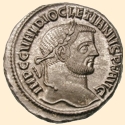
Licinius (Valerius Licinianus Licinius)
Licinius' appointment in 308 as Augustus for the Western half of the empire was not recognized by Constantine, who controlled the mints in Britain and Gaul, nor by Maxentius, who controlled the mints in Italy and Carthage. As a result, the earliest issues of coins in Licinius' name were struck in Siscia—the only mint actually controlled by Licinius—and the other eastern mints controlled by Galerius and Maximinus II. These first post-Carnuntum issues from the eastern mints represented a subtle thematic shift: instead of celebrating GENIO POPVLI ROMANI ("the Genius of the Roman People"), these coins had reverse legends of GENIO AVGVSTI, GENIO CAESARIS, or GENIO IMPERATORIS, celebrating the genius or creative spirit of the emperors themselves. These legends represented the policies of Galerius. When Galerius died in 311 and Licnius took over his Balkan territories and mints, all of the mints in his control began striking the IOVI CONSERVATORI reverse types that became his standard type for the rest of his reign. The first western coins to recognize Licinius were not struck until 310, when the alliance between Constantine and Maximianus/Maxentius had broken down and Maximianus was executed. These coins were struck by Constantine in Londinium and Treveri. Maxentius never struck any coins in Licinius' name, but after Constantine defeated Maxentius in 312, he forged an alliance with Licinius and from that time, coins of Licinius were struck in all of Constantine's mints. Part I: Early post-Carnuntum issues204-361
(click image to see larger picture) Licinius I augustus
—struck by Licinius I
Siscia, 309
obv.- IMP LIC LICINIVS P F AVG; laureate cuirassed bust right
rev.- GENIO AVGVSTI; Genius standing left holding patera in right, cornucopia in left, crescent left, B right, SIS in ex
RIC VI Sis 198b
25mm; 6.7g; nummus
Very first issue of coins struck by Licinius after his appointment as Augustus.
104-825
(click image to see larger picture) Licinius I augustus
—struck by Galerius
Heraclea, 308-309
obv.- IMP C VAL LIC LICINIVS P F AVG; laur bust right
rev.- GENIO IMPERATORIS;
RIC VI Her 37b; Fail 197
27mm; 6.7g; nummus
104-802
(click image to see larger picture) Licinius I augustus
—struck by Maximinus II
Alexandria, 308-310
obv.- IMP C GAL LIC LININIVS P F AVG; laur bust r
rev.- GENIO IMPERATORIS; K-Δ-P in fields, ALE in ex
RIC VI Ale 105b; Fail 197e
24mm; 6.5g; nummus
204-343
(click image to see larger picture) Licinius I augustus
—struck by Maximinus II
Alexandria, 308-310
obv.- IMP C VAL LIC LICINIVS P F AVG; laureate bust right
rev.- GENIO IMPERATORIS; Genius standing left holding a patera and cornucopiae. K in left field, S-P in right field, ALE in ex
RIC VI Ale 107b
25mm; 7.4g; nummus
104-523
(click image to see larger picture) Licinius I augustus
—struck by Galerius
Thessalonica, 308-310
obv.- VAL LICINIVS P F AVG; Laureate head right, divergent laurel ties
rev.- VIRTVTI EXERCITVS; Mars advancing right, nude but for chlamys over left shoulder, helmeted and wearing boots, spear pointing forward in right hand, trophy over left shoulder in left hand
* | B across fields
. SM . TS . in exergue
RIC VI Thes 37b; Fail 212
27mm; 6.8g; nummus
104-556
(click image to see larger picture) Licinius I augustus
—struck by Maximinus II
Cyzicus, 309-310
obv.- VAL LICINNIANVS LICINNIVS P F AVG;
rev.- GENIO AVGVSTI; MKV in ex; B | * in fields
RIC VI Cyz 54; Fail 190h
23mm; 6.0g; nummus
104-824
(click image to see larger picture) Licinius I augustus
—struck by Galerius
Cyzicus, 309-310
obv.- VAL LICINNIANVS LICINNIVS P F AVG; laur bust right
rev.- GENIO IMPERATORIS; Genius; B|* in fields, MKV in ex
RIC VI Cyz 57; Fail 197
27mm; 6.4g; nummus
204-194
(click image to see larger picture) Licinius I augustus
—struck by Maximinus II
Thesalonica, 308–311
obv.- VAL LICINIVS P F AVG; Laureate bust of Licinius facing right
rev.- GENIO AVGVSTI; Genius standing left, holding patera and cornucopiae; * in left field; Γ in right field; •SM•TS• in ex
RIC VI Thes 30b
25mm; 6.4g; nummus
104-760
(click image to see larger picture) Licinius I augustus
—struck by Galerius
Cyzicus, 309-310
obv.- VAL LICINNIANVS LICINNIVS P F AVG; laureate bust right
rev.- VIRTVTI EXERCITVS; Mars standing right, holding spear, shield, standard
RIC VI Cyz 60; Fail 212
26mm; 7.5g; nummus
rated S in RIC
204-080
(click image to see larger picture) Licinius I augustus
—struck by Galerius
Cyzicus, 309-310
obv.- VAL LICINNIANVS LICINNIVS P F AVG; laureate bust right
rev.- VIRTVTI EXERCITVS; Mars standing right, holding spear, shield, standard; B * in fields, MKV in ex
RIC VI Cyz 60; Fail 212
25mm; 6.4g; nummus
rated S in RIC
Part II: Early coins struck by Constantine (after 310)204-351
(click image to see larger picture) Licinius I augustus
—struck by Constantine I
Treveri, 310-313
obv.- IMP LICINIVS P F AVG; laureate cuirassed bust right
rev.- GENIO POP ROM; Genius standing left, holding patera and cornucopiae; T F in fields; PTR in ex
RIC VI Tr 845b
23mm; 4.5g; nummus
First issue of coins struck in Licinius' name by Constantine at one of the Western mints. Although Licinius was appointed Augustus in 308—technically, as ruler of Constantine's territories and superior to Constantine—Constantine refused to recognize Licinius on any of his coins. This coin marks a complete shift in Constantine's policies in 310 : as a consequence of Maximianus' attempted rebellion, Constantine now recognized Licinius and was hostile to Maxentius.
104-835
(click image to see larger picture) Licinius I augustus
—struck by Constantine I
Londinium, 310-312
obv.- IMP LICINIVS P F AVG; laur cuir bust r
rev.- GENIO POP ROM; * in left field; PLN in ex
RIC VI Lon 209c
24mm; 4.7g; nummus
204-279
(click image to see larger picture) Licinius I augustus
—struck by Constantine I
Ostia, 312-313
obv.- IMP LICINIVS P F AVG; Laureate cuirassed bust right
rev.- GENIO POP ROM; Genius standing l, holding patera and cornucopiae; MOSTQ in ex
RIC VI Ost 75b
21mm; 3.8g; nummus
104-770
(click image to see larger picture) Licinius I augustus
—struck by Constantine I
Ostia, 312-313
obv.- IMP LICINIVS P F AVG;
rev.- GENIO POP ROM; Genius standing l, holding patera and cornucopiae; MOSTQ in ex
RIC VI Ost 75
21mm; 3.8g; nummus
204-247
(click image to see larger picture) Licinius I augustus
—struck by Constantine I
Ostia, 312/313
obv.- IMP LICINIVS P F AVG; Laureate cuirassed bust right
rev.- SPQR OPTIMO PRINCIPI; Legionary eagle flanked by two standards, hand on left, wreath on right; flags draped from left and center standards; mintmark worn off, but ought to be MOSTQ
RIC VI Ost 95b; Fail 241
22mm; 4.3g; nummus
This is either the last issue from Ostia, or the first issue from Arelate after the Ostia mint was closed and transferred there. Can make an argument for Arelate based on style, but obverse legend points to Ostia.
Part III: Coins struck by Maximinus II after the death of Galerius104-766
(click image to see larger picture) Licinius I augustus
—struck by Maximinus II
Nicomedia, 311
obv.- IMP C VAL LICIN LICINIVS P F AVG; laur bust right
rev.- HERCVLI VICTORI; Hercules standing right, resting hand on hip and holding club with lion skin; Δ in field; SMN in ex
RIC VI Nic 68 [var]; Fail 201
21mm; 2.9g; nummus
The HERCVLI VICTORI reverse type was only struck occasionally from 311-313 in the mints under control of Maximinus II: Nicomedia, Cyzicus, Antioch, and Alexandria, and, briefly, Heraclea after Maximinus took control of the city from Licinius and struck his own coin types before his defeat. This type is not recorded anywhere for Licinius (except for a single, very rare issue from Alexandria); if it were cataloged, it would be RIC 68a.
204-004
(click image to see larger picture) Licinius I augustus
—struck by Maximinus II
Alexandria, 311-312
obv.- IMP C VAL LIC LICINIVS P F AVG; Laur bust right
rev.- BONO GENIO PII IMPERATORIS; Genius stg facing, head left, pouring liquor from patera, cornucopia in left; crescent-K in left field, B X in right field; ALE in ex
RIC VI Ale 144a (var)
24mm; 7.6g; nummus
Another unlisted variety of this type. This one is unlisted for this obverse legend; 144a is listed as S
204-069
(click image to see larger picture) Licinius I augustus
—struck by Maximinus II
Cyzicus, 312-313
obv.- IMP C VAL LICIN LICINIVS P F AVG; laureate bust right
rev.- GENIO AVGVSTI; Genius standing left, modius on head, holding patera and cornucopea, fire altar at his feet, A in fields, SMK in exergue
RIC VI Cyz 100 [var]
20mm; 4.9g; nummus
Not recorded for this obverse legend
204-019
(click image to see larger picture) Licinius I augustus
—struck by Maximinus II
Antioch, 312
obv.- IMP C LIC LICINNIVS P F AVG; Laur bust right
rev.- GENIO AVGVSTI; Genius standing left, holding head of Sol and cornucopiae; * in left field, I in right field; ANT in ex
RIC VI Ant 164a
20mm; 4.2g; nummus
104-672
(click image to see larger picture) Licinius I augustus
—struck by Maximinus II
Alexandria, 313
obv.- IMP C LIC LICINIVS P F AVG; laureate bust right
rev.- GENIO AVGVSTI; Genius standing left, holding head of Serapis and cornucopia; palm branch-N-* in left field, wreath-Γ in right field; ALE in ex
RIC VI Ale 162a; Fail 190q
22mm; 5.0g; nummus
from a small collection reputed to have been pieced out from Giovanni's Dattari's original collection of Alexandrian coinage. ex. Milivoj Paut
204-165
(click image to see larger picture) Licinius I augustus
—struck by Maximinus II
Nicomedia, 313
obv.- IMP C VAL LICIN LICINIVS P F AVG; Laureate bust of Licinius facing right
rev.- GENIO AVGVSTI; Genius standing left, holding patera and cornucopiae; altar with flames before; * in left field; Δ in right field; SMN in ex
RIC VI Nic [80]
21mm; 4.1g; nummus
"Genius" reverse type is completely missing from RIC for this series, for all emperors. This would have been among the very last coins struck by Maximinus II.
Part IV: Coins struck by Licinius after the death of Galerius204-270
(click image to see larger picture) Licinius I augustus
—struck by Licinius I
Heraclea, 312
obv.- IMP C VAL LICINIAN LICINIVS P F AVG; Laureate head right
rev.- IOVI CONSERVATORI AVGG; Jupiter standing facing, head left, naked but for chlamys over left shoulder, globe in right hand, scepter in left hand. Wreath | Δ across fields; SMHT in ex
RIC VI Her 68
24mm; 5.2g; nummus
I believe this is the only coin that uses this LICINIAN form of Licinius' name.
104-893
(click image to see larger picture) Licinius I augustus
—struck by Licinius I
Heraclea, 312
obv.- IMP C VAL LIC LICINIVS P F AVG; laur bust right
rev.- IOVI CONSERVATORI; Jupiter stg facing, holding globe, leaning on sceptre; wreath in field; SMHT-Δ
RIC VI Her 69 [var]
23mm; 3.7g; nummus
This is yet another uncatalogued variety struck during the war between Licinius and Maximinus II. Coins with mintmark HTA through HT-Δ were issued with wreath in field in 312, anticipating Licinius' 5-year anniversary. Later in 312, SM was added to HT in ex, wth the officina mark in the field, indicating that Licinius and his treasury had taken up residence at Heraclea, in anticipation of the coming battle with Maximinus II. This coin has a transitional mintmark, the same exergual markings of group (ii) but with the SM added — struck presumably towards the end of officina Δ when Licinius arrived, before the the mint marks were reorganized for the next issue. [The obverse of this coin was unfortunately damaged when someone tried to clean the coin with electrolysis and ate into the patina badly. Would be a really nice coin otherwise...] 204-060
(click image to see larger picture) Licinius I augustus
—struck by Licinius I
Thessalonica, 312
obv.- IMP C VAL LIC LICINIVS P F AVG; Laureate head right
rev.- IOVI CONSERVATORI; Jupiter standing facing, head left, naked but for chlamys over left shoulder, globe in right hand, scepter in left
Wreath | Γ across fields; •SM•TS• in ex
RIC VI Thes 49; Fail 202a
24mm; 5.9g; nummus
The high point of Licinius' career came in 313 when, following his alliance with Constantine, he defeated Maximinus II and assumed control over the entire eastern half of the empire. At the beginning of this period, Licinius shared (theoretically, at least) power and rank equally with Constantine. Relations with Constantine however deteriorated steadily until the civil war of 316. The first civil war concluded with a peace treaty favoring Constantine. As part of the treaty, Constantine's two sons and Licinius' son were recognized as caesars and the coinage expanded to include them. The civil war provides a neat division for considering the coinage. For the most part, Licinius' bronze coinage was composed almost exclusively of IOVI CONSERVATORI reverse types. This is in sharp contrast to Constantine, who introduced new coinage programs and types regularly. Licinius' few deviations from his normal patterns are typically motivated by local political considerations involving Constantine. Part I: Coinage struck by Licinius and Constantine post-313204-268
(click image to see larger picture) Licinius I augustus
—struck by Licinius I
Siscia, 313-315
obv.- IMP LIC LICINIVS P F AVG; Laureate bust right
rev.- IOVI CONSERVATORI; Jupiter standing facing, head left, naked but for chlamys over left shoulder, Victory holding wreath in right hand, scepter in left; eagle holding wreath at feet; E in right field; SIS in ex
RIC VII Sis 8
21mm; 3.9g; nummus
104-421
(click image to see larger picture) Licinius I augustus
—struck by Licinius I
Heraclea, 313
obv.- IMP C VAL LICIN LICINIVS P F AVG; laureate bust right
rev.- IOVI CONSERVATORI AVGG; Jupiter standing left, holding Victory and scepter, eagle at feet, SMHT in exergue
RIC VI Her 73; Fail 202g
23mm; 4.1g; nummus
104-724
(click image to see larger picture) Licinius I augustus
—struck by Licinius I
Nicomedia, 313-317
obv.- IMP C VAL LICIN LICINIVS P F AVG; Laureate bust of Licinius facing right
rev.- IOVI CONSERVATORI; Jupiter standing left, chlamys hanging behind, right hand holding a Victory on globe and left leaning on sceptre, an eagle with a wreath at lower left, epsilon in right field, SMN in exergue
RIC VII Nic 13
21mm; 3.6g; nummus
204-398
(click image to see larger picture) Licinius I augustus
—struck by Licinius I
Alexandria, 315
obv.- IMP C VAL LICIN LICINIVS PF AVG; laureate bust right
rev.- IOVI CONSERVATORI AVGG; Jupiter standing left, chlamys across left shoulder, holding Victory on globe and sceptre, eagle with wreath left. Wreath - Γ - N in right field, ALE in ex
RIC VII Ale 8
20mm; 3.1g; nummus
204-346
(click image to see larger picture) Licinius I augustus
—struck by Constantine I
Ticinum, 313
obv.- IMP LICINIVS P F AVG; laureate bust right
rev.- SOLI INVICTO COMITI; Sol radiate standing left, raising right hand, holding globe, chlamys hanging from left shoulder
RIC VII Tic 4
20mm; 2.7g; nummus
104-966
(click image to see larger picture) Licinius I augustus
—struck by Constantine I
Rome, 314
obv.- IMP LICINIVS P F AVG; laureate draped cuirassed bust right
rev.- SOLI INVICTO COMITI; Sol standing left, head radiate, chlamys over left shoulder, raising right hand, globe in left, R*T in exergue, R|F in fields
RIC VII Rom 22
21mm; 3.0g; nummus
104-558
(click image to see larger picture) Licinius I augustus
—struck by Constantine I
Londinium, 315
obv.- IMP LICINIVS P F AVG; Laur Cuir Right
rev.- GENIO POP ROM; Genius standing Left holding Patera + Cornucopia; MSL in ex, S|F in fields
RIC VII Lon 31; Fail 253
20mm; 3.5g; nummus
Not the most artistic portrait of Licinius in the world. Artistry standards at the London mint were not always of the highest caliber in the years before it was shut down. Rated R4 in RIC, scarce in Failmezger
Period II: Post–civil warA number of new coin types were issued following the conclusion of the civil war. One consequence of the truce following the civil war was that Crispus, Constantine II, and Licinius II were officially given the rank of Caesar, a fact that was celebrated on new coinage types at all the mints. However, Licinius and Constantine each continued to issue their own sets of reverse types from their own mints, even though they continued to strike coins in each other's name. 204-274
(click image to see larger picture) Licinius I augustus
—struck by Licinius I
Heraclea, 316-317
obv.- IMP LICINIVS AVG; Laureate, draped bust left, with globe and scepter in left hand, mappa in right hand
rev.- PROVIDENTIAE AVGG; campgate with three turrets, HTΔ in ex.
RIC VII Her 15
20mm; 2.8g; nummus
While Constantine would make the campgate motif ubiquitous within a couple of years on the 20mm bronze coins, this series from Licinius—struck only in Heraclea—actually is where it began. Since Constantine defeated and desposed Licinius before his own campgate coins were issued, these coins from Heraclea are the only campgates struck in Licinius' name. This is, interestingly, the only bronze coin struck by Licinius that doesn't use the otherwise-uibiquitous Jupiter reverse that characterizes all his other bronze coins. This was struck at a sensitive time for Licinius; in 316 Heraclea was the only European mint still in his control, Thessalonica and Siscia being controlled by Constantine after their just-concluded war. The reverse of this coin, with the AVGG legend, implies two Augusti; yet this issue was, extraordinarily, only struck in Licinius' name, not including Constantine, Licinius II, nor his erstwhile co-Augustus, Valens, as negotiations with Constantine were presumably still ongoing. The next issues from this mint do include Constantine and the new caesars, but this single issue testifies to the delicate political situation in Heraclea c. 316. 204-396
(click image to see larger picture) Licinius I augustus
—struck by Licinius I
Cyzicus, 317-320
obv.- IMP LICINIVS AVG; Bust left wearing trabea, in right hand mappa, in left hand globe and sceptre
rev.- IOVI CONSERVATORI AVGG; Jupiter standing left with Victory and sceptre, to left laurel wreath; Δ in field, SMK in ex
RIC VII Cyz 9
17mm; 2.8g; nummus
204-289
(click image to see larger picture) Licinius I augustus
—struck by Licinius I
Antioch, 318
obv.- DD NN IOVII LICINII INVICT AVG ET CAES; Facing laureate busts of Licinius I and Licinius II; Licinius I draped, Licinius II cuirassed, trophy between
rev.- I O M ET VIRTVTI D NN AVG ET CAES; Jupiter tanding left, leaning on scepter,with trophy and captives, SMATΔ in ex
RIC VII Her 50 [var]; Fail 277
23mm; 4.6g; nummus
Licinius struck three varieties of this fascinating type with the distinctive facing busts of himself and his son. Most likely these were struck in 318 to reinforce Licnius' dynastic claims and hold on power following his defeat by Constantine in his civil war. RIC catalogues these coins from Heraclea, Nicomedia, and Cyzicus, but Bastien demonstrated (Numismatic Chronicle 1973—"Coins with a double effigy issued by Licinius at Cyzicus, Nicomedia, and Antioch") that the RIC cataloging is completely incorrect, and that the coins thought to be from Heraclea were actually struck at Antioch. RIC catalogs this type from Heraclea, supposing the mintmark to be SMHTA, and documenting only the single officina A. Bastien demonstrates that what the RIC editors supposed to be H was actually A, and identifies coins from 8 different officina, conclusively pointing to Antioch (while it is not unusual for A, H, and Δ to look very similar on coins from this era, this mintmark is clearly A instead of H, and Δ instead of A). One of the problems with this theory is that nowhere else is Antioch abbreviated AT instead of ANT, but one could surmise that the shorter abbreviation was necessitated by the unusually long reverse legend and limited exergual area. No other coin types are known with this mintmark. In this respect, this Antioch coin is consistent with the Cyzicus and Nicomedia varieties; these coins also were the only types struck in their respective issues. Bastien notes another problem with these coins, which is that they are noticeably larger and heavier than the coins in the immediately preceding and subsequent issues for each mint. This raises the question of precisely what denomination these were intended to represent. It is possible that each type was struck for only a limited period of time, perhaps in conjunction with an imperial visit. This would explain why they were only struck at certain mints, for seemingly a short period of time, and for that time were the only coins struck. Perhaps their larger size and weight indicated a ceremonial importance in connection with the imperial visit?? This particular coin is from Victor Failmezger's collection and is the plate coin for Roman Bronze Coins #277. 204-224
(click image to see larger picture) Licinius I augustus
—struck by Constantine I
Aquileia, 317
obv.- IMP LICINIVS P F AVG; laureate buirassed bust right
rev.- IOVI CONSERVATORI; Jupiter standing left, chlamys over shoulder, holding thunderbolt, leaning on sceptre
RIC VII Aq 7
20mm; 3.4g; nummus
While the IOVI CONSERVATORI coins were ubiquitous in Licinius' territories, this was the only issue of this type struck by any of Constantine's mints. It was only struck for this single issue in 317 following the end of the first civil war between Constantine and Licinius. While this issue from Aquileia include both Sol and Jupiter reverses, the Sol types were only struck in Constantine's name, while the Jupiter types were only struck for Lioinius—foreshadowing the religious divide that would emerge between their two territories. 104-587
(click image to see larger picture) Licinius I augustus
—struck by Constantine I
Treveri, 316
obv.- IMP LICINIVS P F AVG; Laureate draped cuirassed bust of Licinius to right
rev.- GENIO POP ROM; Genius holding cornucopiae and patera; T | F in fields; STR in ex
RIC VII Tr 120; Fail 253
20mm; 3.24g; nummus
204-284
(click image to see larger picture) Licinius I augustus
—struck by Constantine I
Treveri, 318
obv.- IMP LICINIVS AVG; Laureate, draped and cuirassed bust left, holding mappa in right hand, and sceptre over left shoulder
rev.- IOVI CONSERVATORI AVG; Eagle standing right, bearing Licinius who is carrying a thunderbolt and sceptre; STR in ex
RIC VII Tr 211
17mm; 2.77g; nummus
204-136
(click image to see larger picture) Licinius I augustus
—struck by Constantine I
Trier, 318
obv.- IMP LICINIVS AVG; Laureate, draped and cuirassed bust left, holding mappa and sceptre
rev.- IOVI CONSERVATORI AVG; Eagle standing right, bearing Licinius who is carrying a thunderbolt and sceptre; STR in ex
RIC VII Tr 212
17mm; 2.5g; nummus
Rare; rated R3 in RIC.
104-762
(click image to see larger picture) Licinius I augustus
—struck by Constantine I
Arelate, 319
obv.- IMP LICINIVS AVG; laur cuir bust right
rev.- IOVI CONSERVATORI AVG; Jupiter, holding thunderbolt & scepter, carried by eagle standing right, its left wing pointing downward. TARL in ex
RIC VII Arl 192; Fail 278a
18mm; 2.7g; AE3
Rated S in RIC
204-231
(click image to see larger picture) Licinius I augustus
—struck by Constantine I
Thessalonica, 318-319
obv.- IMP LICI NIVS AVG; Laureate cuirassed bust right
rev.- VOT XX MVLT XXX; legend within laurel wreath; •TS•A• in ex
RIC VII Thes 33
19mm; 2.0g; nummus
104-518
(click image to see larger picture) Licinius I augustus
—struck by Constantine I
Thessalonica, 319
obv.- IMP LICINIVS AVG; laureate cuirassed bust right
rev.- VICTORIA AVGG NN; Victory advancing left holding wreath, ·TS·A· in ex
RIC VII Thess 61; Fail 287
19mm; 3.0g; nummus
RIC rated R2
204-196
(click image to see larger picture) Licinius I augustus
—struck by Constantine I
Thessalonica, 319
obv.- IMP LICINIVS AVG; Laureate and cuirassed bust right
rev.- VIRT EXERC; Sol, raising right hand and holding globe in left, standing slightly left in center of plan of Roman camp; •TS•A• in ex
RIC VII Thes 68
19mm; 2.4g; nummus
Rare; rated R3 in RIC. Most of these were struck in the name of Constantine, examples struck in the names of Licinius or the caesars are decidedly more scarce.
104-551
(click image to see larger picture) Licinius I augustus
—struck by Constantine I
Siscia, 320
obv.- IMP LICINIVS AVG; Laureate head right, divergent laurel ties
rev.- VIRTVS EXERCIT; standard inscribed VOT XX with captives seated on ground to either side, S to left, F & HL monogram right, BSIS(*-in-crescent) in ex
RIC VII Sis 129; Fail 291
27mm; 6.8g; nummus
rated R in RIC
Part III: Sole coinage, before final defeat by ConstantineAfter 320-321, coinage patterns changed once more as relations between Constantine and Licinius deteriorated again. In response, the western mints under Constantine's control began to cease striking coins in the name of Licinius and Licinius II. For the final years of Licinius' reign, the only bronze coin types were IOVI CONSERVATORI types, struck in the names of himself and his son. A small number of very rare coins were also struck in the names of Valens (317, during first civil war) and Martinian (324, during the second civil war)—unfortunate colleagues who were appointed by Licinius as co-augustus in the waning days of each war. 104-576
(click image to see larger picture) Licinius I augustus
—struck by Licinius I
Heraclea, 321-324
obv.- IMP C VAL LICIN LICINIVS P F AVG; Radiate bust right, cuirassed
rev.- IOVI CONSERVATORI; Jupiter stg. l., chlamys across l. shoulder, leaning on sceptre with eagle, Victory on globe in r. hand; eagle holding wreath to l.; to r., captive on ground; in field, X and IIG; SMHG in ex
RIC VII Her 52; Fail 320
21mm; 2.9g; AE3
The exact date of Licinius' birth isn't known—estimates range from 250 to 263. His full real name is likewise unknown. He was born a peasant in Dacia, in the central Balkans. Eventually he became a military commander in Galerius' forces while Galerius was caesar. He served in Galerius' campaigns against the Persians in 297/298; then served as a commander along the Danube frontier; and was one of Galerius' commanders during Severus' and, later, Galerius' own failed expeditions to oust Maxentius from Italy. In 307 he was sent as Galerius' envoy to Maxentius in an effort to dislodge the usurper, but was again unsuccessful. At the Carnuntum Conference in 308 (convened to resolve the messy situation in the West following the revolt of Maxentius and ), Licinius was appointed Augustus for the western half of the Empire. Historians have puzzled over this choice : Constantine was established as the legitimate Caesar in the West, having been recognized by Galerius himself, and ought to be have been promoted to Augustus. Since Licinius had never served as Caesar, his appointment as Augustus would have been sure to provoke both Constantine and Maximinus II (as it in fact did). However, Galerius wanted someone loyal to himself, and Licinius was no doubt chosen because he happened to be right there, at the head of a body of troops, instead in some remote locale. Lactantius gives a date of Nov. 11, 308 for his appointment, but recent scholarship suggests Dec. 26 as the more likely date. Unfortunately, Licinius' appointment changed nothing in the West. Following the failed attempt to dislodge Maxentius, neither he nor Galerius chose to challenge the even more formidable Constantine. Despite his title as Augustus of the West, Licinius effectively controlled only the province of Pannonia, near Carnuntum itself. In 310 Licinius achieved his first notable military success in his new office, defeating the Sarmatians along the Danube frontier. The uneasy state of imperial affairs persisted until the death of Galerius in 311. Licinius then took over all of Galerius' territories in Europe, effecting a hostile truce with Maximinus II, who assumed control over all the Asian territories. Early in 312, Licinius and Constantine struck an alliance. This gave Licinius support against Maximinus, while freeing Constantine to move against Maxentius without worrying about Licinius operating on his flank. After the defeat of Maxentius, Licinius and Constantine celebrated their alliance in Milan in 313. They jointly issued the Edict of Milan, ending the Christian persecutions in the East, and Licinius married Constantine's half-sister. These measures provoked Maximinus to launch a pre-emptive strike against Licinius. Licinius quickly moved east and defeated Maximinus, taking complete control of the eastern half of the empire. This represented the zenith of his power, though. Future conflict with Constantine was inevitable, and political instability in Pannonia, the border province between their two territories, gave Constantine a pretext to move in his forces in 316. The first civil war concluded in 317 with Constantine assuming control over most of the European territories. In addition, Constantine's two sons (Crispus and Constantine II) and Licinius' son (Licinius II) were appointed as caesars—the first such appointees since Constantine and Maximinus in 305. One of the more sorry episodes of Licinius' reign occurred following his defeat of Maximinus. Before his death, Galerius had entrusted Licinius with the safety of his wife, Valeria (Diocletian's daughter), and Prisca, who was Valeria's mother and Diocletian's wife. However, Valeria didn't trust Licinius and fled to Maximinus' court, where Maximinus II tried to marry her (even though she was his aunt). When she refused, she was badly mistreated and persecuted. However, after Licinius defeated Maximinus, he also executed Valeria, in 314, along with Prisca and Candidianus, Galerius' young son. He also executed Maximinus' wife and two young children, and—just to be extra-thorough—executed Severianus, son of Severus II. A second war with Constantine followed in 324, and in this engagement Constantine sought a decisive victory. The final great battle, fought at Chrysopolis on Sept. 18, 324, was one of the largest battles ever fought by Roman forces. As many as 250,000 soldiers may have fought on land. In addition, a concurrent naval battle involved as many as 500 ships. Licinius was defeated soundly and retreated into Asia. A final battle was avoided when his wife—Constantine's sister—negotiated with her brother to spare Licinius and arrest him instead. This was done, but Constantine (probably inevitably) wound up executing Licinius anyway the next year. |
Timeline265–265 — Born in Dacia/Moesia. 297/298 — Serves in Persian war with Galerius. 307 — Serves in Galerius' expedition to Italy against Maxentius. Nov. 11/Dec. 26, 308 — Appointed Augustus at Carnuntum Conference. 309 — Serves as Consul (with Constantine). 310 — Defeats Sarmatians in campaign along Danube frontier. 311 — Galerius dies. Licinius assumes control over European territories. 312 — Consulate II. 313 —Consulate III. March 313 — Marries Constantia, half-sister of Constantine. Publishes Edict of Milan with Constantine. April 313 — Maximinus II invades Licinius territory. Takes Byzantium, Heraclea. April 313 — Licinius defeats Maximinus at Campus Ergenus. July 313 — Licinius publishes Edict of Milan in Nicomedia. Maximinus captured and killed at Tarsus. 313/314 — Campaigns against Persians. 314 — Executes Galeria Valeria along with all surviving family members from Galerius, Maximinus, and Severus. 315 — Consulate IV. Son is born (Licinius II). 316/317 — First civil war with Constantine. Defeated Feb 317 at Adrianople. 317 — Celebrates decennalia. Licinius II appointed caesar. 318 — Consulate V. 320 — Begins to implement anti-Christian programs. 324 — Second war with Constantine. Defeated at Hebrus River in July; later, naval defeat off Byzantium. Sept. 18, 324 — Defeated at Chrysopolis. Abdicates and is imprisoned in Thessalonica. Spring 325 — Executed by Constantine. |