![]()
Rome
|
||
|
Go to mint...
|
Rome (Diœcesis Italiciana, province of Tvscia et Vmbria)
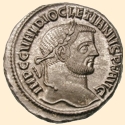
The mainstay Roman coin through the Severan dynasty—the middle of third century AD—was the pure silver denarius. A smaller silver coin of half the weight was infrequently struck, called the quinarius. The main bronze coin was the sestertius (a denarius was worth 4 sestertii), with the gold coin being the aureus. By the end of the Severan years, the silver coins were getting increasingly debased, so that a new coin was introduced, worth 2 denarii, called the antoninianus. The antoninianus gradually replaced the denarius as the workhorse common coin. As all the coins became more and more debased—containing more and more bronze, and less and less silver—the traditional bronze denominations became increasingly useless. By the time Diocletian assumed power, all of the existing mints were striking massive numbers of base antoniniani (bronze with a slight silver wash), while other denominations were struck rarely. Rome was one of the few mints that continued to strike traditional denarii & quiinarii, albeit in very small numbers. By this time the denarius had devolved to a completely base bronze fraction with no silver at all. This page has examples of the three formerly silver coins as struck by the Rome mint just before Diocletian's coinage reform in 294. When Diocletian instituted his massive new coinage in 294, the common antoninianus was preserved as a fraction of the new silvered bronze nummus ; the other traditional denominations were swept away. The nummus was supposed to fill the role of the sestertius as the standard coin for common transactions, while the denarius was replaced by the argenteus. 204-257
(click image to see larger picture) Diocletian augustus
—struck by Diocletian
Rome, 285
obv.- IMP DIOCLETIANVS AVG; Laureate draped cuirassed bust right
rev.- VICTORIA AVG; Victory walking left, holding wreath and palm
RIC V.ii Rom 188
18mm; 2.3g; denarius
Rare bronze denarius; this denomination was struck only at Rome, and infrequently at that. This coin is one of the very first coins from the whole Tetrarchy era; it was struck at the very beginning of Diocletian's reign, before Maximianus was appointed co-ruler. This coin represents, essentially, the last denarii struck in the empire. Rated R2 in RIC.
204-260
(click image to see larger picture) Diocletian augustus
—struck by Maximianus
Rome, 290
obv.- IMP DIOCLETIANVS AVG; Radiate, draped, and cuirassed bust right
rev.- IOVI FVLGERATORI; Jupiter standing facing, head right, preparing to hurl thunderbolt; at feet to left, eagle standing left, head right; XXIΔ
RIC V.ii Rom 168
23mm; 4.04g; antoninianus
From the White Mountain collection.
204-089
(click image to see larger picture) Maximianus augustus
—struck by Maximianus
Rome (?)
obv.- MAXIMIANVS AVG; laureate bust right
rev.- HERCVLI DEBALLAT; Hercules, stg.l., holding club and lion’s skin, fighting Hydra
RIC – ; King, Roman Quinarii p.424, no. 2
16mm; 1.13g; quinarius
Rare and uncataloged variety, it's not clear where and when this was struck. Note from dealer:
My own opinion is Rome mint, based on the pattern of other small issues of fractions and also the portrait style. RIC attributes an issue of small unmarked fractions to 305; alternatively, this could have been struck before the coinage reform, when other quinarii and denarii were struck at Rome in the years before 294.
104-741
(click image to see larger picture) Maximianus augustus
—struck by Maximianus
Rome, 294-295
obv.- IMP C MA MAXIMIANVS P F AVG; laur bust right
rev.- GENIO POPVLI ROMANI; Genius standing left, holding patera in left hand, cornucopiae in right; R in field
RIC VI Rom 44a; Fail 006
27mm; 12.86g; nummus
First issue from Rome
204-007
(click image to see larger picture) Maximianus augustus
—struck by Maximianus
Rome, 295-297
obv.- MAXIMIANVS AVG; laur bust right
rev.- VICTORIA SARMAT; Four princes sacrificing over tripod/altar before gate in six-turreted enclosure; ε in ex
RIC VI Rom 37b
18mm; 3.1g; argenteus
Listed as R3
204-328
(click image to see larger picture) Maximianus augustus
—struck by Maximianus
Rome, 296-297
obv.- IMP C MA MAXIMIANVS P F AVG; laureate bust right
rev.- GENIO POPVLI ROMANI; Genius standing left, holding patera in left hand, cornucopiae in right; R in field, A in ex
RIC VI Rom 63
27mm; 9.5g; nummus
104-733
(click image to see larger picture) Maximianus augustus
—struck by Maximianus
Rome, 296-297
obv.- IMP C MAXIMIANVS P F AVG; laur bust right
rev.- GENIO POPVLI ROMANI; Genius standing left, holding patera in left hand, cornucopiae in right; R in field, S in ex
RIC VI Rom 64b; Fail 006
28mm; 10.23g; nummus
204-049
(click image to see larger picture) Galerius caesar
—struck by Maximianus
Rome, 296-297
obv.- GAL VAL MAXIMIANVS NOB C; laureate bust right
rev.- GENIO POPVLI ROMANI; Genius standing left modius on head, holding cornucopiae with chlamys over left shoulder, patera in right; R in left field, Z in ex
RIC VI Rom 66b
27mm; 9.5g; nummus
listed as S in RIC
204-202
(click image to see larger picture) Maximianus augustus
—struck by Maximianus
Rome, 297-298
obv.- IMP MAXIMIANVS P F AVG; radiate bust right
rev.- VOT XX; Laurel wreath surrounding legend; θ in ex
RIC VI Rom 82
20mm; 2.0g; half-nummus
These votive fractions were struck in anticipation of the vicennalia of Diocletian and Maximianus (20th anniversary = VOT XX), and the decennalia of Constantius and Galerius (10th anniversary = VOT X). The anniversary would have been in 303, so these were struck 5 years in advance to proclaim the emperor's vows of service that would be fulfilled 5 years hence. 104-988
(click image to see larger picture) Diocletian augustus
—struck by Maximianus
Rome, 299
obv.- IMP C DIOCLETIANVS P F AVG; laur bust right
rev.- GENIO POVLI ROMANI; Genius standing facing, head left, holding patera and cornucopia; P* in ex
RIC VI Rom 94a
28mm; 9.5g; nummus
204-389
(click image to see larger picture) Galerius caesar
—struck by Constantius I
Rome, 300-301
obv.- MAXIMIANVS NOB CAES; laureate bust right
rev.- SACRA MON VRB AVGG ET CAESS NN; Moneta standing left, holding scales and cornucopia; Q(thunderbolt) in ex
RIC VI Rom 99b
27mm; 9.9g; nummus
104-953
(click image to see larger picture) Constantius I caesar
—struck by Maximianus
Rome, 300-301
obv.- CONSTANTIUS NOC CAES; laureate bust right
rev.- SACRA MON VRB AVGG ET CAESS NN; Moneta standing left, holding scales and cornucopia; T-club in ex
RIC VI Rom 102a
28mm; 11.1g; nummus
The club is used as a mint-control mark, but also symbolizes Hercules, since Constantius (and Maximianus) were supposed to be from the House of Hercules—contrast with the lightning bolt that symbolized Jupiter, used for Galerius and Diocletian.
204-291
(click image to see larger picture) Galerius caesar
—struck by Maximianus
Rome, 300-301
obv.- MAXIMIANVS NOB CAES; Laureate bust right
rev.- SACRA MON VRB AVGG ET CAESS NN; Moneta standing left, holding scales and cornucopia; Q-thunderbolt in ex
RIC VI Rom 102b
28mm; 10.4g; nummus
The lightning bolt is used as a mint-control mark, but also symbolizes Jupiter, since the eastern emperors, Galerius and Diocletian, were supposed to be from the House of Jupiter —contrast with the club that symbolized Hercules, used for the western emperors Constantius and Maximianus, in this same issue. From the Elliott-Kent Collection. Ex Langtoft Hoard 104-738
(click image to see larger picture) Constantius I caesar
—struck by Maximianus
Rome, 302-303
obv.- CONSTANTIVS NOB CAES; laur bust right
rev.- SAC MON VRB AVGG ET CAESS NN; Moneta standing left, right hand holding scales, cornucopiae in left. * in field, RT in ex
RIC VI Rom106a; Fail 028
28mm; 9.4g; nummus
204-269
(click image to see larger picture) Constantius I caesar
—struck by Maximianus
Rome, 303-305
obv.- CONSTANTIVS NOB CAES; laureate bust right
rev.- SAC MON VRB AVGG ET CAESS NN; Moneta standing left, scales in right hand, cornucopiae in left ; R-crescent-T in exergue
RIC VI Rom 112a
28mm; 9.2g; nummus
104-737
(click image to see larger picture) Galerius caesar
—struck by Maximianus
Rome, 303-305
obv.- MAXIMIANVS NOB CAES; laur bust right
rev.- SAC MON VRB AVGG ET CAESS NN; Moneta standing left, holding scales in right hand, cornucopiae in left; R(crescent)Q in ex
RIC VI Rom112b; Fail 028
29mm; 9.52g; nummus
104-982
(click image to see larger picture) Maximianus sr aug
—struck by Severus II
Rome, 305
obv.- D N MAXIMIANO FELICISS SEN AVG; laureate bust right in imperial mantle & holding branch & mappa
rev.- PROVIDENTIA DEORVM QVIES AVGG; Providence standing right, extending hand to Quies, standing left, holding branch; S F in field; RS in ex
RIC VI Rom 119b
28mm; 8.9g; nummus
listed as R2 in RIC. Not recorded for this officina. There is possibly a wreath between the R-S—which perhaps got filled in in the die—
in this case, the coin would be RIC 131b, struck in 306.
104-786
(click image to see larger picture) Constantius I augustus
—struck by Severus II
Rome, 305
obv.- IMP C CONSTANTIVS P F AVG; laur bust right
rev.- SAC MON VRB AVGG ET CAESS NN; Moneta stg left
RIC VI Rom 120a; Fail 053
27mm; 8.6g; nummus
rated S in RIC
204-024
(click image to see larger picture) Severus II caesar
—struck by Severus II
Rome, 305
obv.- SEVERVS NOB CAES; laureate bust right
rev.- SAC MON VRB AVGG ET CAESS NN; Moneta standing left, holding scales and cornucopia; RT in ex
RIC VI Rom 123a
28mm; 9.7g; nummus
Listed as S in RIC
104-990
(click image to see larger picture) Maximinus II caesar
—struck by Severus II
Rome, 305
obv.- MAXIMINUS NOB CAES; laureate bust right
rev.- SACRA MON VRB AVGG ET CAESS NN; Moneta standing left, holding scales and cornucopia; * in r field; ; RQ in ex
RIC VI Rom 123b
29mm; g; nummus
Rated S in RIC
204-025
(click image to see larger picture) Severus II augustus
—struck by Severus II
Rome, 306
obv.- IMP C SEVERVS P F AVG; laureate bust right
rev.- SAC MON VRB AVGG ET CAESS NN; Moneta standing left, holding scales and cornucopia; R-wreath-S in ex
RIC VI Rom 158b
28mm; 9.7g; nummus
Listed as S in RIC. The "Moneta" types were struck much later at Rome than at the other mints. Not only is it the only mint to strike these coins for Severus II, but this coin is struck for him during the short time that he reigned as Augustus. The other mints nominally under his control had long since shifted to a variety of military reverse types, reflecting the impending conflicts with Maxentius and Constantine, so the continuance of this early, politically unremarkable type from the first Tetrarchy suggests that perhaps he was not exerting very active control over the Rome mint, even before Maxentius overtly revolted.
104-553
(click image to see larger picture) Maximianus sr aug
—struck by Maxentius
Rome, 307
obv.- IMP C MAXIMIANVS P F AVG; laur b r
rev.- CONSERVATORES VRB SVAE; Roma std facing, head l, in hexastyle temple, holding globe and sceptre; knobs as acroteria; plain pediment
RIC VI Rom 194b; Fail 127d
24.5mm; 6.4g; nummus
104-751
(click image to see larger picture) Maxentius augustus
—struck by Maxentius
Rome, 307
obv.- MAXENTIVS P F AVG;
rev.- CONSERVATORES VRB SVAE; Roma seated facing, in hexastyle temple, globe in right hand, scepter in left, shield at side, plain pediment, knobs as acroteria; R*T in ex
RIC VI Rom 195; Fail 127d
26mm; 6.1g; nummus
listed S in RIC
204-121
(click image to see larger picture) Constantine I caesar
—struck by Maxentius
Rome, 307
obv.- CONSTANTINVS NOB CAES; laureate bust right
rev.- CONSERVATO-RES VRB SVAE; Roma seated facing, head l., in hexastyle temple r. holding globe and sceptre (plain pediment); R * Q in ex
RIC VI Rom 196
25mm; 5.7g; nummus
104-954
(click image to see larger picture) Constantine I augustus
—struck by Maxentius
Rome, 307
obv.- CONSTANTINVS P F AVG; laur bust right
rev.- CONSERVATORES VRB SVAE; Roma seated facing, head left, in hexastyle temple, globe in right hand, scepter in left, wreath in pediment, knobs as acroteria
R*Q in exergue
RIC VI Rom 201
27mm; 6.1g; nummus
rated S in RIC
204-182
(click image to see larger picture) Maxentius augustus
—struck by Maxentius
Rome, 307-308
obv.- IMP C MAXENTIVS P F AVG; Laureate bust right
rev.- CONSERV VRB SVAE; Roma seated facing, head left, in hexastyle temple, holding globe and sceptre, wreath in pediment; Victories as acroteria; H in left field; RS in ex
RIC VI Rom 202a
25mm; 6.3g; nummus
104-843
(click image to see larger picture) Maxentius augustus
—struck by Maxentius
Rome, 308-310
obv.- IMP C MAXENTIVS P F AVG; laur bust right
rev.- CONSERV VRBS SVAE; Roma seated facing, head l., in hexastyle temple, holding globe and sceptre; Victories as acroteria; Dioscuri in pediment between two circular altars; In ex RBT
RIC VI Rom 208; Fail 127j
26mm; 7.9g; nummus
Ex. Harlan J Berk
104-969
(click image to see larger picture) Maxentius augustus
—struck by Maxentius
Rome, 308-310
obv.- IMP C MAXENTIVS P F AVG; laureate bust right
rev.- MARTI COMITI AVG N; Mars advancing right carrying spear and shield, captive at feet, RBT in ex
RIC VI Rom 220; Fail 137
24mm; 5.7g; nummus
Rare. Plate coin for Failmezgar "Roman Bronze Coins" (Plate 7). ex Tory Failmezgar collection; ex Tom Cederland, 2001
104-648
(click image to see larger picture) Romulus commem
—struck by Maxentius
Rome, 310
obv.- DIVO ROMVLO N V CONS; bare head right
rev.- AETERNAE MEMORIAE; domed round temple with an open door surmounted by an eagle with open wings. RQ in ex
RIC VI Rom 239; Fail 168
17mm; 1.7g; quarter-nummus
Rated R in Failmezger. From the Father Wilbur B. Dexter Collection.
204-301
(click image to see larger picture) Maxentius augustus
—struck by Maxentius
Rome, 310
obv.- MAXENTIVS P F AVG; bust right with lion-skin headdress
rev.- VOT X FEL; legend in three lines surrounded by wreath; RQ in ex
RIC VI Rom 241; Fail 174
19mm; 2.6g; half-nummus
From the White Mountain Collection.
104-845
(click image to see larger picture) Constantius I commem
—struck by Maxentius
Rome, 310-311
obv.- IMP MAXENTIVS DIVO CONSTANTIO COGN; Veiled bust right
rev.- AETERNAE MEMORIAE; Eagle, wings spread, standing right, head left, on domed shrine with four columns, door ajar
RIC VI Rom 245; Fail 117
24mm; 4.9g; nummus
Rated as S in RIC
104-856
(click image to see larger picture) Galerius commem
—struck by Maxentius
Rome, 311
obv.- MAXENTIVS DIVO MAXIMIANO SOCERO; veiled bust facing right
rev.- AETERNAE MEMORIAE; domed tetrastyle temple, elaborate Corinthian columns, eagle perched on roof, lattice work panels on either side, REQ in ex
RIC VI Rom 248; Fail 117
26mm; 6.8g; nummus
rated S in RIC
204-059
(click image to see larger picture) Maxentius augustus
—struck by Maxentius
Rome, 310-311
obv.- IMP C MAXENTIVS P F AVG; laur bust r
rev.- VICTORIA AVG N; Victory advancing left, holding wreath and palm; REP in ex
RIC VI Rom 272; Fail 155
25mm; 6.5g; nummus
ex. Tory Failmezger collection. plate coin for Failmezger's "Roman Bronze Coins" (plate 8)
104-829
(click image to see larger picture) Maxentius augustus
—struck by Maxentius
Rome, 310-311
obv.- IMP C MAXENTIVS P F AVG; laur bust r
rev.- VICT[ORIA] AVG N; Victory standing right, handing globe to seated Maxentius; REQ in ex
RIC VI Rom 274 (var); Fail 157var
25mm; 5.1g; nummus
Completely unknown reverse type, but would be part of the Victory series, RIC 272-274 (page 384); this would presumably follow 274.
204-338
(click image to see larger picture) Maxentius augustus
—struck by Maxentius
Rome, 310
obv.- MAXENTIVS P F AVG; laureate bust right
rev.- VOT QQ • MVL X; legend in four lines surrounded by wreath
RIC VI Rom 281c
17mm; 1.9g; third-nummus?
204-117
(click image to see larger picture) Constantine I augustus
—struck by Constantine I
Rome, 312-313
obv.- FL VAL CONSTANTINVS AVG; laureate and draped bust, seen from rear
rev.- PACI PERPET; Pax stg. facing, head l., r. holding branch, l. standard
in left field- XII in exergue- RT
RIC VI Rom 355
17mm; 2.3g; half-nummus
104-965
(click image to see larger picture) Constantine I augustus
—struck by Constantine I
Rome, 312-313
obv.- IMP CONSTANTINVS P F AVG; laureate cuirassed bust right
rev.- GENIO POPVLI ROMANI; Genius stg left, holding patera and cornucopia; RS in ex
RIC VI Rom 294a
23mm; 4.6g; nummus
One of the first things Constantine did when he captured Rome from Maxentius was issue his own coins, especially the GENIO standard. I like the cartoon-like depiction of Genius on this coin, I wish the face was better struck.
104-955
(click image to see larger picture) Constantine I augustus
—struck by Constantine I
Rome, 312-313
obv.- IMP CONSTANTINVS P F AVG; Laureate, draped and cuirassed bust r.
rev.- SPQR OPTIMO PRINCIPI; Legionary eagle between two Vexilla, the left surmounted by a hand and the right wreath; RP in ex
RIC VI Rom 350a
23mm; 4.7g; nummus
104-660
(click image to see larger picture) Maximinus II augustus
—struck by Constantine I
Rome, 312-313
obv.- IMP MAXIMINVS P F AVG; laureate draped cuirassed bust right
rev.- SPQR OPTIMO PRINCIPI; Legionary eagle facing left between two standards; RP in ex
RIC VI Rom 350b; Fail 241
23mm; 4.1g; nummus
There's actually a nice coin underneath the green crust, it's just hard to tell. Sigh...
204-142
(click image to see larger picture) Constantine I augustus
—struck by Constantine I
Rome, 313
obv.- IMP CONSTANTINVS P F AVG; Laureate draped cuirassed bust right
rev.- MARTI CONSERVATORI; Mars standing right, right arm resting on inverted spear, left on shield, R/F in fields; RP in ex
RIC VII Rom 6
21mm; 3.1g; nummus
Listed R3 in RIC
104-468
(click image to see larger picture) Constantine I augustus
—struck by Constantine I
Rome, 314 AD
obv.- IMP CONSTANTINVS P F AVG; laureate draped bust right
rev.- SOLI INVICTO COMITI; Sol standing left, holding orb. R F in fields (Roma felicitas ?), R-star-S in ex
RIC VII Rom 19, Fail 258a
20mm; 2.9g; nummus
104-966
(click image to see larger picture) Licinius I augustus
—struck by Constantine I
Rome, 314
obv.- IMP LICINIVS P F AVG; laureate draped cuirassed bust right
rev.- SOLI INVICTO COMITI; Sol standing left, head radiate, chlamys over left shoulder, raising right hand, globe in left, R*T in exergue, R|F in fields
RIC VII Rom 22
21mm; 3.0g; nummus
204-359
(click image to see larger picture) Constantine I augustus
—struck by Constantine I
Rome, 316
obv.- IMP CONSTANTINVS PF AVG; laureate draped cuirassed bust right
rev.- SOLI INVICT CO[M DN]; Sol standing left with right hand raised and Victory on globe in left hand, ✶∪ in fields
RIC VII Rom 48
18mm; 3.4g; nummus
Very scarce variety with Sol holding Victory. Rated R4 in RIC
104-994
(click image to see larger picture) Constantine I augustus
—struck by Constantine I
Rome, 317-318
obv.- IMP CONSTANTINVS P F AVG; laureate draped cuirassed bust right
rev.- SOLI INVICTO COMITI; Sol standing left, head radiate, chlamys over left shoulder, raising right hand, globe in left, RT in exergue, wreath in field
RIC VII Rom 97
22mm; 3.8g; nummus
204-095
(click image to see larger picture) Maximianus commem
—struck by Constantine I
Rome, 317-318
obv.- DIVO MAXIMIANO SEN FORT IMP; Maximianus, laureate and veiled bust right
rev.- REQVIES OPTIM-ORVM MERITORVM; Emperor sitting on curule chair holding sceptre
RIC VII Rom 104; Fail 332
21mm; 3.0 g; nummus
much larger flan than expected for this issue; should be about 18mm. See http://www.oudgeld.com/webbib/conscomm.htm for more info about this coin (article by Gert Boersema, originally from Celator).
104-533
(click image to see larger picture) Constantius I commem
—struck by Constantine I
Rome, 317-318
obv.- DIVO CONSTANTIO PIO PRINC; Constantius, laureate and veiled bust right
rev.- MEMORIAE ATERNAE; eagle standing right, looking left; RP in ex
RIC VII Rom 111; Fail 333
17mm; 1.8g; half-nummus
Struck by Constantine to commemorate his deceased and now-deified father. Part of a series that also honored his purported ancestor, Claudius II Gothicus, and his father-in-law, Maximianus, to emphasize to the populace Constantine's illustrious ancestry. 204-376
(click image to see larger picture) Constantine II caesar
—struck by Constantine I
Rome, 320
obv.- CONSTANTINVS IVN NOB C; lareate draped cuirassed bust right
rev.- ROMAE AETERNAE; Roma seated right, holding shield on her lap inscribed X V; R ερωC S in exergue
RIC VII Rom 200
18mm; 2.9g; nummus
rated as R4 in RIC. From Gert Boersema : This is a coin with the famous eros mintmark in the exergue. To the left and to the right the letters R and [S] stand for officina [secunda] Romae ‘the [second] workshop of Rome’. The word eros is written in Greek, with the letters epsilon, rho and omega in a ligature. There was probably a pun intended: Eros translates into Latin as Amor, and Amor is an anagram for Roma. The wordplay Amor-Roma is known from the temple of Venus and Roma, which had these words written on the walls, and from a pun in Virgil’s Aenid. cf. http://www.vcoins.com/ancient/gertboersema/store/viewItem.asp?idProduct=502 204-219
(click image to see larger picture) Constantine I augustus
—struck by Constantine I
Rome, 321
obv.- CONSTANTINVS AVG; Laureate bust right
rev.- D N CONSTANTINI MAX AVG; Legend surrounding laurel wreath, enclosing VOT / • / XX RQ in ex
RIC VII Rom 237
19mm; 3.03g; nummus
204-203
(click image to see larger picture) Constantine I augustus
—struck by Constantine I
Rome, 324-325
obv.- CONSTANTINVS AVG; laureate bust right
rev.- PROVIDENTIAE AVGG; campgate (8 layers) with two turrets, star above; in ex.: RP
RIC VII Rom 264
19mm; 4.0g; nummus
204-253
(click image to see larger picture) Constantine I augustus
—struck by Constantine I
Rome, 326
obv.- [none]; laureated bust right - no legend
rev.- CONSTANTINVS AVG; wreath with legend below; SMRS in ex
RIC VII Rom 281; Fail 335
18mm; 2.4g; nummus
204-265
(click image to see larger picture) Fausta augusta
—struck by Constantine I
Rome, 326
obv.- FLAV MAX FAVSTA AVG; bust right with wavy hair, draped and jeweled
rev.- SPES REIPVBLICAE; Fausta holding a pair of her children; R-wreath-P in ex
RIC VII Rom 292
20mm; 3.0g; nummus
Rated R4 in RIC. Not common from Rome mint.
Diocletian's reign—and later, Constantine's—captured a significant transition in the political status of Rome. Before Diocletian, the "Roman empire" was organized as a large number of provinces that were administered by the government of the city of Rome. Most of the territory in the Italian peninsula was considered to be, administratively, part of Rome. Hence its people were Roman citizens, and exempt from taxes. "Rome" the empire was funded largely by taxes remitted from the provinces. By the middle of the third century, Rome's effective political importance was receding rapidly. Breakaway states were established in Gaul, Britain, and Syria; barbarian invaders moved through the Balkans, Asia Minor, and Italy itself; and new emperors came to power from the provinces via control of their legions, and rarely, if ever, visited Rome itself. One of Diocletian's great reforms was reorganizing Roman territory into a new system of provinces and dioceses, in which Rome, and Italy, became just one of several provinces. This is kind of like the US abolishing the District of Columbia and making Washington just another city in Maryland. Citizens of Rome, and Italy, also lost their exemption from taxation and would be treated like any other citizens. Instead of residing in Rome, Diocletian established his capital at Nicomedia; his co-emperor, Maximianus, established the western capital at Mediolanum in northern Italy, a further blow to Rome's status. Rome fell in the administrative sphere of Maximianus, along with the other Italian mints. Like them, all the bronze coins initially were of the Genius type, followed by the "Sacra Moneta" motif after 301. Moneta types persisted at Rome throughout the brief reign of Severus, who nominally succeeded Maximianus as ruler of Italy in 305, until the revolt of Maxentius. Rome never strikes the military types that characterized Ticinum and Aquileia during this period, perhaps reflecting a lack of effective direct control of the city. Rome mint under Maxentius. The unpopularity of Diocletian's reforms in Italy created the conditions that enabled Maxentius to successfully rebel and take control of Rome and the rest of Italy in 306. Maxentius' coinage expresses the emotional appeal of his political program. Traditional civic symbols of Rome—the Temple of Roma, the Dioscuri, wolf-and-twins, and Victory—are featured on his coinage, completely replacing the empire-wide motifs such as Genius Populi Romani that were intended to convey imperial unity. Maxentius struck numerous coins at Rome in the name of Constantine, his supposed ally against the eastern emperors—at least until his break with Constantine in 308. He also struck numerous coins in the name of his father, Maximianus, who was installed as his co-ruler. His initial claim to power rested on his descent from Maximianus and his alliance with Constantine. No coins were struck for Galerius, Licinius, or Maximinus—except, curiously, a commemorative coin on the death on Galerius. Rome mint under Constantine. Constantine initiated another wholesale reform of the coinage when he took control of the city. "Genius" coins were struck again, emphasizing Rome's re-integration with the empire. Sol was introduced with the same design as Constantine's other mints. Constantine also struck coins commemorating his victory and control of the city: SPQR OPTIMO PRINCIPI—"The Senate and People of Rome, to the best of Princes." Under Constantine, the Rome mint also again struck coins in the names of the other imperial colleagues, Licinius and Maximinus II. Constantine's conquest of the city in 312 was the linchpin of a crucial period in Christian, and Western, history. In 311, Galerius died and cancelled the last great Christian persecutions. In 312, Constantine defeated Maxentius under a Christian flag at the Milvian Bridge, leading directly to the Edict of Milan in 313 that legalized Christianity. Also in 313, the violently anti-Christian Maximinus II (who had succeeded Galerius in the East) committed suicide after his defeat by Licinius. Constantine took additional, decisive steps that furthered Rome's political decline, culminating in the refounding of Byzantium as the new capital of Constantinople, including a new Senate to rival Rome's. However, at the same time, the Church at Rome benefitted greatly from his patronage. Constantine donated the Basilica of St. John Lateran to the Church and constructed the Lateran Palace, which were consecrated in 324 as the seat of the Pope. He also began constructing St. Peter's Basilica in 323. By greatly increasing the status of the Church and the Pope, while continuing to deemphasize Rome's political importance, Constantine emphatically began to transform Rome's role from political capital to a religious one, controlled by the Church and Pope.
|
Timeline753 BC — Semi-legendary founding of Rome by Romulus and Remus. 509 BC — King of Rome is overthrown and replaced by two consuls; Republic begins. 390 BC — City is sacked by Celts from Gaul. 133 BC — Tiberius Gracchus assasinated for attempted reforms. 88 BC — Civil war between Sulla and Marius begins when Sulla invades Rome. 81 BC — Sulla declared dictator for life. Republic falls apart over next 50 years. 42 AD — Peter arrives in Rome. Martyred in ~64-67. 64 AD — Great fire destroys much of city. 80 AD — Colosseum (begun by Vespasian in 72) completed by Titus. 296-304 — Marcellinus is Bishop of Rome. The word Pope dates from his reign. 306 — Maxentius takes control of Rome. 307 — City is beseiged— unsuccessfully—by Galerius. 312 — Constantine defeats Maxentius at Milvian Bridge and assumes control of city. 323 — Constantine builds St. Peter's Basilica on site of Peter's crucifixion. 402 — Honorius makes Ravenna capital of western empire instead of Rome. 410 — Rome is sacked by Goths under Alaric. 455 — Rome is sacked again, this time by Vandals. 476 — Odoacer kills emperor and disbands Senate. Recognized as dux Italiae by emperor in Constantinople. 536 — Belisarius recaptures Rome for Byzantine emperor Justinian. Rome becomes part of Exarchate of Italy, ruled by local duke. 663 — Visit by Constans II, Byzantine emperor. Last time an emperor would ever visit Rome. 756 — Franks conquer Italy. Pepin the Short gives control of Rome to the Pope ("Donation of Pepin"), establishing the Papal States. 800 — Pope crowns Charlemagne Emperor in Rome. 846 — Saracens attack Rome, damaging St. Peter's. 1309-1337 — Papacy moves to Avignon. 1527 — Sacked by troops of Emperor Charles V; Pope taken prisoner. 1870 —Royalist troops of King Vittorio Emanuele II of Sardinia capture city. Rome becomes capital of unified Kingdom of Italy.
|