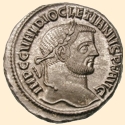
Galerius

Galerius (Gaius Galerius Valerius Maximianus)

Coins of Galerius are divided into two pages. Page 1 includes coins struck during the first Tetrarchy, when he ruled as Diocletian's Caesar. Page 2 includes coins struck when he reigned as Augustus, and the commemorative coins struck after his death.

  • Coins as Caesar
  • Coins as Augustus
  • Biography...

Early coinage in the East

104-772
Thumbnail image of coin

(click image to see larger picture)

Galerius caesar
—struck by Maximianus
Siscia, 299
obv.- MAXIMIANVS NOB CAES; laur bust right
rev.- GENIO POPVLI ROMANI; B in field, SIS in ex
RIC VI Sis 109b; Fail 006
29mm; 10.3g; nummus
The reverse is still crusted with the original, "as-found" hoard patina and a layer of hard soil. This coin shows the contrast between the cleaned and uncleaned regions pretty clearly. Some people prefer their coins completely cleaned, some people prefer that they remain uncleaned, as found.
204-102
Thumbnail image of coin

(click image to see larger picture)

Galerius caesar
—struck by Maximianus
Siscia, 300
obv.- MAXIMIANVS NOB CAES; laureate bust right
rev.- GENIO POPVLI ROMANI; Genius standing left, holding patera and cornucopia; L-B in fields, XXISIS in ex
RIC VI Sis 122
27mm; 11.2g; nummus
204-242
Thumbnail image of coin

(click image to see larger picture)

Galerius caesar
—struck by Galerius
Heraclea, 295
obv.- MAXIMIANVS CAESAR; Laureate bust right
rev.- VIRTVS MILITVM; four tetrarchs sacrificing in front of gateway of six turreted enclosure; HΔ in ex
RIC VI Her 8; RSC 220a
18mm; 3.3g; argenteus
Rated R3 in RIC
104-901
Thumbnail image of coin

(click image to see larger picture)

Galerius caesar
—struck by Galerius
Heraclea, 296-297
obv.- GAL VAL MAXIMIANVS NOB CAES; laur bust right
rev.- GENIO POPVLI ROMANI; Genius standing left holding a patera and cornucopiae. HT-Δ in ex
RIC VI Her 18b
27mm; 10.3g; nummus
104-745
Thumbnail image of coin

(click image to see larger picture)

Galerius caesar
—struck by Galerius
Thessalonica, 298
obv.- GAL VAL MAXIMIANVS NOB CAES; laureate bust right
rev.- GENIO POPVLI ROMANI; Genius standing left, holding patera and cornucopia; TSA in exergue
RIC VI Thes 20b; Fail 006
28mm; 11g; nummus
first issue from Thessalonica
204-330
Thumbnail image of coin

(click image to see larger picture)

Galerius caesar
—struck by Galerius
Serdica, 303-305
obv.- GAL VAL MAXIMIANVS NOB CAES; laureate bust right
rev.- GENIO POPVLI ROMANI; Genius standing left, holding patera in right hand, cornucopiae in left; B in field; •SM•SD• in ex
RIC VI Ser 4b
28mm; 10.7g; nummus
104-746
Thumbnail image of coin

(click image to see larger picture)

Galerius caesar
—struck by Galerius
Serdica, 303
obv.- GAL VAL MAXIMIANVS NOB CAES; laureate bust right
rev.- GENIO POPVLI ROMANI; Genius standing left, holding patera and cornucopia;B in field; •SM•SD• in exergue
RIC VI Ser 4b; Fail 025
28mm; 10.1g; nummus
first issue from Serdica
104-722
Thumbnail image of coin

(click image to see larger picture)

Galerius caesar
—struck by Diocletian
Cyzicus, 295-296
obv.- GAL VAL MAXIMIANVS NOB CAES; l-b-r
rev.- GENIO AVGG ET CAESARVM NN; Genius standing facing, head left, emptying patera, KA in exergue
RIC VI Cyz 9b; Fail 005
28mm; 8.4g; nummus
rated S in RIC
204-300
Thumbnail image of coin

(click image to see larger picture)

Galerius caesar
—struck by Diocletian
Cyzicus, 297-298
obv.- GAL VAL MAXIMIANVS NOB CAES; laureate bust right
rev.- GENIO AVGG ET CAESARVM NN; Genius standing facing, head left, , holding patera from which liquid flows and cornucopia, KA in exergue
RIC VI Cyz 11b
28mm; 9.2g; nummus
Essentially as struck, with remarkably complete silvering. Hard to believe a coin could survive in this condition.
204-217
Thumbnail image of coin

(click image to see larger picture)

Galerius caesar
—struck by Diocletian
Nicomedia, 303-304
obv.- GAL VAL MAXIMIANVS NOB CAES; Laureate bust right
rev.- GENIO POPVLI ROMANI; Naked Genius standing l. pouring liquid from patera and holding cornucopia; SMNB in ex
RIC VI Nic 30b
27mm; 9.6g; nummus
Rated Scarce in RIC.
104-888
Thumbnail image of coin

(click image to see larger picture)

Galerius caesar
—struck by Diocletian
Antioch, 294-295
obv.- GAL VAL MAXIMIANVS NOB CAES; laur bust right
rev.- GENIO POPVLI ROMANI; Genius standing left, patera in right, cornucopia in left, star left, Z right, ANT in ex
RIC VI Ant 45b
26mm; 10.2g; nummus
first issue from Antioch mint
104-822
Thumbnail image of coin

(click image to see larger picture)

Galerius caesar
—struck by Diocletian
Antioch, 299-300
obv.- GAL VAL MAXIMIANVS NOB CAES; laur bust right
rev.- GENIO POPVLI ROMANI; Genius; Γ in field, ANT in ex
RIC VI Ant 53b; Fail 006
27mm; 9.2g; nummus


204-267
Thumbnail image of coin

(click image to see larger picture)

Galerius caesar
—struck by Diocletian
Alexandria, 297-298?
obv.- GAL VAL MAXIMIANVS NOB CAES; radiate draped cuirassed bust right
rev.- CONCORDIA MILITVM; Prince standing right in military dress, receiving Victory on globe from Jupiter, leaning on scepter; A in field, ALE in ex
RIC VI Ale 48b
23mm; 3.5g; antoninianus
These smaller coins were intended to complement the larger nummi as a fractional denomination. These were tariffed as 2 denarii, vs. 5 denarii for the larger full-sized nummi. As such, they represent a continuation of the pre-reform antoninianus from before 294, which was originally introduced as a 2-denarius coin. However, these coins no longer made any pretense of having any silver content or silver wash, and were simply pure bronze. The silver wash was instead used for the larger bronze coins. It is not clear what these coins were called, post-294 — the literature refers to them simply as "radiate fractions" — but I've kept the pre-reform term "antoninianus" since the nominal value is the same.
104-552
Thumbnail image of coin

(click image to see larger picture)

Galerius caesar
—struck by Diocletian
Alexandria, 304-305
obv.- GAL VAL MAXIMIANVS NOB CAES; laur b r
rev.- IOVI CONS CAES; Jupiter holding l, holding Victory on globe, leaning on sceptre; S|A/P in fields, ALE in ex
RIC VI Ale 43; Fail 27
26mm; 10.5g; nummus

Early coinage in the West

204-135
Thumbnail image of coin

(click image to see larger picture)

Galerius caesar
—struck by Maximianus
Treveri, 296-297
obv.- MAXIMIANVS NOB CAES; Laureate bust right; H under bust
rev.- GENIO POPVLI ROMANI; Genius standing left, holding patera and cornucopia; modius on head; B Γ in fields, TR in ex
RIC VI Tr 214b
26mm; 10.2g; nummus
Folles with an H under the bust are rare and seldom seen
104-763
Thumbnail image of coin

(click image to see larger picture)

Galerius caesar
—struck by Constantius I
Treveri, 296-297
obv.- MAXIMIANVS NOB CAES; laureate bust left
rev.- GENIO POPVLI ROMANI; Genius left; B-Γ in fields, TR in ex
RIC VI Tr 220b; Fail 006
27mm; 9.1g; nummus
104-826
Thumbnail image of coin

(click image to see larger picture)

Galerius caesar
—struck by Constantius I
Treveri, 298-299
obv.- MAXIMIANVS NOBIL CAES; laur bust r
rev.- FORTVNAE REDVCI CAESS NN; Fortuna, wearing long dress, standing facing, diademed head turned l., holding cornucopiae in her l. hand, rudder with her r. hand; at her side, wheel; A|* in field, TR in ex
RIC VI Tr 259b; Fail 004
29mm; 11.14g; nummus
204-258
Thumbnail image of coin

(click image to see larger picture)

Galerius caesar
—struck by Constantius I
Treveri, 298-299
obv.- MAXIMIANVS NOBIL C; Laureate, helmeted, draped, cuirassed bust left, holding spear over right shoulder, left arm holding shield
rev.- GENIO POPVLI ROMANI; Genius standing left, holding patera & cornucopia, modius on head; B in left field, * in right field, TR in ex
RIC VI Tr 347 var
28mm; 7.2g; nummus
Unlisted in RIC with this bust type (AA) and legend (4d) combination; closest matching type has NOBIL CAES legend
104-818
Thumbnail image of coin

(click image to see larger picture)

Galerius caesar
—struck by Constantius I
Treveri, 298-299
obv.- MAXIMIANVS NOB CAES; laur cuir bust right
rev.- GENIO POPVLI ROMANI; Genius; B|* in fields, TR in ex
RIC VI Tr 358b; Fail 006
28mm; 9.9g; nummus
104-902
Thumbnail image of coin

(click image to see larger picture)

Galerius caesar
—struck by Constantius I
Lugdunum, 296
obv.- C Val MAXIMIANVS NOB C; laur bust r
rev.- GENIO POPVLI ROMANI; Genius standing left, holding patera and cornucopia; no mintmark
RIC VI Lug 17b
28mm; 11.5g; nummus
listed as S in RIC. Class I high relief bust
104-897
Thumbnail image of coin

(click image to see larger picture)

Galerius caesar
—struck by Maximianus
Lugdunum, 298
obv.- MAXIMIANVS NOB CAES; laur bust right
rev.- GENIO POPVLI ROMANI; Genius standing left holding a patera and cornucopiae. A in left field, PL in ex
RIC VI Lug 53b
28mm; 7.2g; nummus
204-388
Thumbnail image of coin

(click image to see larger picture)

Galerius caesar
—struck by Constantius I
Lugdunum, 301-303
obv.- CONSTANTIVS NOB CAES; Laureate bust right, wearing trabea and holding eagle-tipped sceptre
rev.- GENIO POPVLI ROMANI; Genius standing left, holding patera and cornucopia, in front altar; A in field, PLC in ex
RIC VI Lug 146 [var]
28mm; 10.1g; nummus
This bust type -- a right-facing "consular" bust -- is not listed in RIC for any Lugdunum issue. However, this type is known for both Treveri and Londinium, so it ought to be expected for Lugdunum also. Galerius and Constantius both served as consuls in 302, so it is logical that the coins were struck at that time.
204-049
Thumbnail image of coin

(click image to see larger picture)

Galerius caesar
—struck by Maximianus
Rome, 296-297
obv.- GAL VAL MAXIMIANVS NOB C; laureate bust right
rev.- GENIO POPVLI ROMANI; Genius standing left modius on head, holding cornucopiae with chlamys over left shoulder, patera in right; R in left field, Z in ex
RIC VI Rom 66b
27mm; 9.5g; nummus
listed as S in RIC
104-769
Thumbnail image of coin

(click image to see larger picture)

Galerius caesar
—struck by Maximianus
Rome, 297-298
obv.- MAXIMIANVS NOB CAES; radiate bust right
rev.- VOT XX; inscription in wreath; theta in ex
RIC VI Rom 88b; Fail 023
20mm; 2.9g; half-nummus
204-389
Thumbnail image of coin

(click image to see larger picture)

Galerius caesar
—struck by Constantius I
Rome, 300-301
obv.- MAXIMIANVS NOB CAES; laureate bust right
rev.- SACRA MON VRB AVGG ET CAESS NN; Moneta standing left, holding scales and cornucopia; Q(thunderbolt) in ex
RIC VI Rom 99b
27mm; 9.9g; nummus
204-291
Thumbnail image of coin

(click image to see larger picture)

Galerius caesar
—struck by Maximianus
Rome, 300-301
obv.- MAXIMIANVS NOB CAES; Laureate bust right
rev.- SACRA MON VRB AVGG ET CAESS NN; Moneta standing left, holding scales and cornucopia; Q-thunderbolt in ex
RIC VI Rom 102b
28mm; 10.4g; nummus

The lightning bolt is used as a mint-control mark, but also symbolizes Jupiter, since the eastern emperors, Galerius and Diocletian, were supposed to be from the House of Jupiter —contrast with the club that symbolized Hercules, used for the western emperors Constantius and Maximianus, in this same issue.

From the Elliott-Kent Collection. Ex Langtoft Hoard

104-962
Thumbnail image of coin

(click image to see larger picture)

Galerius caesar
—struck by Maximianus
Ticinum, 296-297
obv.- MAXIMIANVS NOB CAES; laur bust right
rev.- GENIO POPVLI ROMANI; Genius stg left, modius on head, holding cornucopia and patera; * in field; PT in ex
RIC VI Tic 32b
29mm; 10.0g; nummus
104-847
Thumbnail image of coin

(click image to see larger picture)

Galerius caesar
—struck by Maximianus
Ticinum, 300-303
obv.- MAXIMIANVS NOB CAES; laur bust right
rev.- SACRA MONET AVGG ET CAESS NOSTR; Moneta stg. l., r. hldg. scales, l. cornucopia; ST• in ex
RIC VI Tic 46b
29mm; 9.2g; nummus
104-777
Thumbnail image of coin

(click image to see larger picture)

Galerius caesar
—struck by Maximianus
Aquileia, 296
obv.- MAXIMIANVS NOB CAES; laur bust right
rev.- GENIO POPVLI ROMANI; Genius standing l, holding patera and cornucopiae;
RIC VI Aquileia 24b; Fail 006
29mm; 10.5g; nummus
204-307
Thumbnail image of coin

(click image to see larger picture)

Galerius caesar
—struck by Maximianus
Aquileia, 300
obv.- MAXIMIANVS CAESAR; laureate bust right
rev.- XCVI AQ; legend surrounded by wreath
RIC VI Aq 17b, RSC 250b
19mm; 3.04g; argenteus
XCVI indicates the value of the coin = 96 / pound of silver. This was issued in connection with the monetary reform of 300-301 and indicates the new value of this denomination.
104-964
Thumbnail image of coin

(click image to see larger picture)

Galerius caesar
—struck by Maximianus
Aquileia, 301
obv.- MAXIMIANVS NOB CAES; laur bust right
rev.- SACRA MONET AVGG ET CAESS NOSTR; Moneta standing with balance scales and conucopiae; V in field; AQ-Γ in ex
RIC VI Aq 32b
28mm; 8.8g; nummus
104-436
Thumbnail image of coin

(click image to see larger picture)

Galerius caesar
—struck by Maximianus
Aquileia, 302-303 AD
obv.- MAXIMIANVS NOB CAES; Laureate bust right.
rev.- SACRA MONET AVGG ET CAESS NOSTR; Moneta standing left holding scales + cornucopia; III (VI?) in fields; in ex, A Q G
RIC VI Aq 36b; Fail 28
28mm; 8.6g; nummus
struck as caesar, 293-305 AD
104-737
Thumbnail image of coin

(click image to see larger picture)

Galerius caesar
—struck by Maximianus
Rome, 303-305
obv.- MAXIMIANVS NOB CAES; laur bust right
rev.- SAC MON VRB AVGG ET CAESS NN; Moneta standing left, holding scales in right hand, cornucopiae in left; R(crescent)Q in ex
RIC VI Rom112b; Fail 028
29mm; 9.52g; nummus
104-973
Thumbnail image of coin

(click image to see larger picture)

Galerius caesar
—struck by Maximianus
Carthage, 298-299
obv.- MAXIMIANVS NOB CAES; laur bust right
rev.- SALVIS AVGG ET CAESS FEL KART; Karthago standing facing, head left, in long robe, fruits in both hands ; Δ in ex
RIC VI Car 30b
27mm; 8.9g; nummus
One of my favorite portraits in my collection. Listed as S in RIC
204-334
Thumbnail image of coin

(click image to see larger picture)

Galerius caesar
—struck by Constantius I
Londinium, 300
obv.- MAXIMIANVS NOB CAES; laureate cuirassed bust right
rev.- GENIO POPVLI ROMANI; Genius standing left holding patera and cornucopia;no mint mark
RIC VI Lon 15
26mm; 9.9g; nummus
204-037
Thumbnail image of coin

(click image to see larger picture)

Galerius caesar
—struck by Constantius I
London, 300-303
obv.- C VAL MAXIMIANVS NOB C; laur cuirassed bust right
rev.- GENIO POPVLI ROMANI; Genius standing left, modius on head, holding patera and cornucopia
RIC VI Lon 20 [var]
28mm; 9.8g; nummus
This legend is only listed for the RIC Class II.a nummi, which otherwise consists of the "Carausian" style portraits — crude portraits with small head on the exaggerated long neck. This coin is clearly of the "Lugdunese" portrait style and ought to be Class II.b. Even though this legend is not listed for Galerius for thie groups, it ought to be expected for this group, since a corresponding form exists for Constantius, and the legend forms are also paired in this way in Class II.a. This would be catalogued as RIC 20b. Ex. Dr. J. S. Vogelaar Collection.
104-921
Thumbnail image of coin

(click image to see larger picture)

Galerius caesar
—struck by Constantius I
Londinium, 303-305
obv.- MAXIMIANVS NOB CAES; Laureate, draped and cuirassed bust right, seen from behind
rev.- GENIO POPVLI ROMANI; Genius standing left, holding patera and cornucopia; no mint mark
RIC VI Lon 36 [var]
29mm; 9.0g; nummus
RIC 36 is for bust type seen from front (D); bust type from rear (C) not listed for this type. (Bust type C is only listed for a single type from this issue, for Diocletian.)


204-164
Thumbnail image of coin

(click image to see larger picture)

Galerius caesar
—struck by Constantius I
Lugdunum, 302-303
obv.- MAXIMANIVS NOB CAES; laureate, cuirassed bust left, holding sceptre over right shoulder
rev.- GENIO POPVLI ROMANI; Genius standing left, modius on head, holding patera over altar to left, cornucopia in right, B to right, PLC in ex
RIC VI Lug 167b
28mm; 10g; nummus
104-827
Thumbnail image of coin

(click image to see larger picture)

Galerius caesar
—struck by Constantius I
Lugdunum, 301-303
obv.- MAXIMIANVS NOB C; Laureate bust left, wearing imperial cloak, holding in his r. hand eagle-tipped sceptre
rev.- GENIO POPVLI ROMANI; Genius, nude but for chlamys over l. shoulder, standing facing, head with modius turned l., holding cornucopiae in his l. hand, sacrificing over lite altar out of patera in his r. hand; A in field, PLC in ex
RIC VI Lug 169b; Fail 025c
30mm; 10.2g; nummus
Bastien, Lyon 283c (this specimen, illustrated on pl. 26).
104-641
Thumbnail image of coin

(click image to see larger picture)

Galerius caesar
—struck by Constantius I
Lugdunum, 303-305
obv.- MAXIMIANVS NOB C; laureate cuirassed bust right
rev.- GENIO POPVLI ROMANI; Genius holding cornucopiae and patera over alter; star in field; PLC• in ex
RIC VI Lug 178b; Fail 025c
28mm; 9.4g; nummus
From the Father Wilbur B. Dexter Collection.
104-941
Thumbnail image of coin

(click image to see larger picture)

Galerius caesar
—struck by Constantius I
Treveri, 302-303
obv.- GAL VAL MAXIMIANVS NOB C; laureate draped [cuirassed?] bust right
rev.- MONETA S AVGG ET CAESS NN; Moneta standing with balance scales and conucopiae; S F in fields; ITR in ex
RIC VI Tr 553b
27mm; 9.1g; nummus
Rated R in RIC for laur-draped-cuirassed bust (type D); unlisted for laur-draped bust (type B)

Coins struck by Severus II

At the time of Galerius' promotion to Augustus, the western mints were controlled by Constantius—also promoted to Augustus—and Severus II, who was appointed caesar in the West and took over the mints formerly controlled by the now-retired Maximianus.

104-445
Thumbnail image of coin

(click image to see larger picture)

Galerius augustus
—struck by Severus II
Ticinum, 306 AD
obv.- IMP C MAXIMIANVS P F AVG; laureate bust right
rev.- FIDES MILITVM; Fides seated left holding two standards; TT in ex
RIC VI Tic 59b; Fail 43
28mm; 9.7g; nummus

204-092
Thumbnail image of coin

(click image to see larger picture)

Galerius augustus
—struck by Severus II
Aquileia, 305-306
obv.- IMP MAXIMIANVS P F AVG; Laureate head right
rev.- FIDES MILITVM AVGG ET CAESS NN; Fides standing left, holding two standards; AQP in ex.
RIC VI Aq 60b; Fail 44
29mm; 9.5g; nummus
Uncleaned, with original hoard patina. Really nice coin under the green encrustations.
104-657
Thumbnail image of coin

(click image to see larger picture)

Galerius augustus
—struck by Severus II
Aquileia, 305-306
obv.- IMP MAXIMIANVS P F AVG; helmeted bust left; holding spear and shield
rev.- VIRTVS AVGG ET CAESS NN; Prince with shield, galloping right, spearing kneling foe, second foe prostrate on ground; AQP in ex
RIC VI Aq 66b; Fail 056
28mm; 9.2g; nummus
rated R in RIC, R in Fail
104-867
Thumbnail image of coin

(click image to see larger picture)

Galerius augustus
—struck by Severus II
Carthage, 305-306
obv.- IMP MAXIMIANVS P F AVG; laur bust right
rev.- SALVIS AVGG ET CAESS FEL KART; Carthage standing, holding fruits in both hands
RIC VI Car 39b; Fail 054
26mm; 9.6g; nummus


204-119
Thumbnail image of coin

(click image to see larger picture)

Galerius augustus
—struck by Severus II
Siscia, 305-306
obv.- IMP MAXIMIANVS P F AVG; laureate bust right
rev.- HERCVLI VICTORI; Hercules naked standing left holding lion's skin and three apples and leaning on club. VI in left field, SISΓ in exergue
RIC VI Sis 165b
28mm; 9.0g; nummus
rated S in RIC
204-259
Thumbnail image of coin

(click image to see larger picture)

Galerius augustus
—struck by Severus II
Siscia, 305-306
obv.- MAXIMIANVS AVG; Laureate bust right
rev.- GENIO POPVLI ROMANI; Naked Genius standing l. holding patera in right hand and cornucopia in left; SIS in ex (but off the flan)
RIC VI Sis 169b
17mm; 2.0g; quarter-nummus
204-181
Thumbnail image of coin

(click image to see larger picture)

Galerius augustus
—struck by Severus II
Siscia, 305-307
obv.- IMP MAXIMIANVS P F AVG; laureate bust right
rev.- IOVI CONSERVAT; Jupiter standing facing, head left, holding small Victory on globe; VI in field; SISA in ex
RIC VI Sic 179b
27mm; 10.8g; nummus


Coins struck by Constantine

After 306, the western mints were controlled by Constantine, who assumed control over his father Constantius' territories, and by Maxentius, who rebelled against Severus II—and by extension, Galerius. Constantine continued striking coins for Galerius as a gesture of political good will, but the open rebellion of Maxentius precluded any such gesture on his part. Constantine himself stopped striking coins for Galerius after his alliance with Maxentius. As such, no coins were struck in Galerius' name in the West after 307.

204-403
Thumbnail image of coin

(click image to see larger picture)

Galerius augustus
—struck by Constantine I
Treveri, 307
obv.- IMP MAXIMIANVS PF AVG; laureate cuirassed bust right
rev.- GENIO POP ROM; Genius standing left, towered, naked except for chlamys over left shoulder, holding patera in r. hand and cornucopiae in l. one. S-A across fields. Mintmark PTR in ex.
RIC VI Tr 714
27mm; 6.6g; nummus
This is the last issue of coins struck by Constantine for Galerius before his alliance with Maximianus and consequent formal break with the eastern emperors.
204-312
Thumbnail image of coin

(click image to see larger picture)

Galerius augustus
—struck by Constantine I
Lugdunum, 307
obv.- IMP MAXIMIANVS P F AVG; laureate, draped, cuirassed bust right
rev.- GENIO POPVLI ROMANI; Genius standing left, left shoulder and loins draped, holding patera and cornucopia, S C in field, PLC in exergue
RIC VI Lug 224/225 [var]
24mm; 6.4g; nummus

For this issuewith the S-C marks in the fieldsRIC only catalogs 2 types, one each of Diocletian and Maximianus, as senior augusti. RIC does include a footnote, "Voetter includes a Genio Pop Rom issue for Constantine in this group. I have seen no trace of it anywhere." This coin for Galerius therefore rounds out the issue, demonstrating that this was not a special issue for just the senior augusti, but in fact included all the emperors. Extremely rare; this is not listed in either RIC or in Bastien's "Le monnayage de l’atelier de Lyon", but it is cited in Lyon supp. I 446α1 (this coin) with only one other example cited.

This S-C issue must have been struck immediately after the revolt of Maxentius, accompanying the "unretirement" of Maximianus. As such, this would be the last coin struck for Galerius at any of the western mints (except for some commemorative coins struck by Maxentius after his death). Even after Constantine's recognition of Licinius in 310, when he began striking coins in the name of Licinius, he did not strike any coins for Galerius.


Coins struck in the East before Carnuntum

An important numismatic divide in the East was the Carnuntum Conference at the end of 308. Following this conference, Licinius was appointed Augustus, taking over the newly reopened Siscia mint.

104-670
Thumbnail image of coin

(click image to see larger picture)

Galerius augustus
—struck by Galerius
Heraclea, 305-306
obv.- IMP C GAL VAL MAXIMIANVS P F AVG; laureate bust right
rev.- GENIO POPVLI ROMANI; Genius standing facing, head left, modius on head, naked but for chlamys over left shoulder, liquors flowing from patera in right hand, cornucopiae in left; HT-epsilon in exergue
RIC VI Her 24b; Fail 46a
29mm; 10.2g; nummus
204-356
Thumbnail image of coin

(click image to see larger picture)

Galerius augustus
—struck by Galerius
Serdica, 305-306
obv.- IMP C GAL VAL MAXIMIANVS P F AVG; laureate bust right
rev.- GENIO POPVLI ROMANI; Genius standing left, holding patera and cornucopiae; Δ in field; •SM•SD• in ex
RIC VI Ser 12b
28mm; 10.4g; nummus
104-833
Thumbnail image of coin

(click image to see larger picture)

Galerius augustus
—struck by Galerius
Serdica, 305-306
obv.- IMP C GAL VAL MAXIMIANVS P F AVG;
rev.- GENIO POPVLI ROMANI; Genius; Δ in field; •SM•SD• in ex
RIC VI Ser 12b; Fail 046
28mm; 10.35g; nummus
204-160
Thumbnail image of coin

(click image to see larger picture)

Galerius augustus
—struck by Galerius
Serdica, 307-308
obv.- GAL MAXIMIANVS P F AVG; laureate bust right
rev.- VIRTVS EXERCITVS; Mars advancing right, holding transverse spear in right hand, trophy over left shoulder; * Γ in fields, • SM•SD• in ex
RIC VI Ser 44
27mm; 6.5g; nummus
Relatively common type from other mints, but rare from Serdica. Listed as S in RIC. Soon as I can find one in better condition, I'll buy it...
104-492
Thumbnail image of coin

(click image to see larger picture)

Galerius augustus
—struck by Galerius
Nicomedia, 307-308
obv.- IMP C GAL VAL MAXIMIANVS P F AVG; Laureate head right
rev.- GENIO AVGVSTI CH; Genius standing left, modius on head, naked but for chlamys over left shoulder, liquors flowing from patera in right hand, cornucopiae in left; SMNA in ex.
RIC VI Nic 51; Fail 191; Sear 3718
25mm; 7.0g; nummus
CMH most likely is a value mark, indicating 48 coins per pound of bronze. Rated R in RIC.
104-723
Thumbnail image of coin

(click image to see larger picture)

Galerius augustus
—struck by Galerius
Cyzicus, 308
obv.- IMP C GAL VAL MAXIMIANVS P F AVG; l-b-r
rev.- GENIO IMPERATORIS; Genius standing facing, head left, emptying patera
RIC VI Cyz 35; Fail 190h
27mm; 5.3g; nummus
104-742
Thumbnail image of coin

(click image to see larger picture)

Galerius augustus
—struck by Galerius
Cyzicus, 308
obv.- IMP C GAL VAL MAXIMIANVS P F AVG; l-b-r
rev.- VIRTVS MILITVM; Campgate with 4 turrets, no doors
RIC VI Cyz 39; Fail 214
27mm; 6.4g; nummus
104-792
Thumbnail image of coin

(click image to see larger picture)

Galerius augustus
—struck by Maximinus II
Antioch, 308
obv.- IMP C GAL VAL MAXIMIANVS P F AVG; Laureate head right
rev.- VIRTVTI EXERCITVS; Virtus advancing right in military dress, spear in right hand, shield and trophy over left shoulder in left hand ; crescent-A in right field; ANT • in ex
RIC VI Ant 99; Fail 212
24mm; 6.5g; nummus
rated S in RIC


Coins struck in the East after Carnuntum

104-756
Thumbnail image of coin

(click image to see larger picture)

Galerius augustus
—struck by Licinius I
Siscia, 310
obv.- IMP MAXIMIANVS P F AVG; laur bust right
rev.- GENIO AVGVSTI; Genius steht links hält Patera und Füllhorn; crescent|A in field, SIS in ex
RIC VI Sis 207a; Fail 190b
24mm; 6.8g; nummus
204-385
Thumbnail image of coin

(click image to see larger picture)

Galerius augustus
—struck by Galerius
Nicomedia, 309-311
obv.- IMP C GAL VAL MAXIMIANVS P F AVG; Laureate bust right
rev.- GENIO AVGVSTI CMH; Genius standing left, holding cornucopia and patera, SMNA in ex
RIC VI Nic 54a/66a
26mm; 6.8g; nummus
104-785
Thumbnail image of coin

(click image to see larger picture)

Galerius augustus
—struck by Galerius
Cyzicus, 308-309
obv.- GAL MAXIMIANVS P F AVG; Laureate head right
rev.- VIRTVTI EXERCITVS; Mars advancing right, naked but for floating chlamys, spear pointing forward in right hand, trophy over shoulder in left hand; B in left field; MKV in ex
RIC VI Cyz 47; Fail 212
27mm; 7.6g; nummus
204-397
Thumbnail image of coin

(click image to see larger picture)

Galerius augustus
—struck by Maximinus II
Antioch, 309-310
obv.- IMP C GAL VAL MAXIMIANVS PF AVG; laureate bust right
rev.- GENIO IMPERATORIS; Genius standing left, modius on head, naked except for chlamys over left shoulder (falls low), holding patera from which liquid flows, and cornucopiae; altar in left field; Z in rt field; ANT in ex
RIC VI Ant 119a
24mm; 6.3g; nummus
104-582
Thumbnail image of coin

(click image to see larger picture)

Galerius augustus
—struck by Maximinus II
Antioch, 310
obv.- IMP C GAL VAL MAXIMIANVS P F AVG; laur b r
rev.- GENIO IMPERATORIS; Genius over altar; ANT in ex; * | B in fields
RIC VI Ant 133a; Fail 197d
24mm; 7.0g; nummus
204-282
Thumbnail image of coin

(click image to see larger picture)

Galerius augustus
—struck by Maximinus II
Alexandria, 308-310
obv.- IMP C GAL VAL MAXIMIANVS P F AVG; laureate bust right
rev.- GENIO IMPERATORIS; Genius of the emperor standing left, chlamys over shoulder, modius on head, pouring libation from patera & holding cornucopiae; K-E-P in fields, ALE in ex
RIC VI Ale 101a
25mm; 6.6g; nummus
104-983
Thumbnail image of coin

(click image to see larger picture)

Galerius augustus
—struck by Maximinus II
Alexandria, 308-310
obv.- IMP C GAL VAL MAXIMIANVS P F AVG; laureate bust right
rev.- VIRTVS EXERCITVS; Virtus advancing right, holding spear, shield, and trophy, ALE in exergue, K/SP in fields
RIC Vi Ale 111a
24mm; 7.5g; nummus
Listed as S in RIC


Post-Carnuntum coinage struck in the West

According to the standard reference works and the accepted patterns of coins struck by Constantine, this coin isn't supposed to exist!

204-401
Thumbnail image of coin

(click image to see larger picture)

Galerius augustus
—struck by Constantine I
Treveri, 310-311
obv.- IMP MAXIMIANVS P F AVG; laureate cuirassed bust right
rev.- GENIO POP ROM; Genius standing l., modius on head, naked but for chlamys over l. shoulder, Genius standing left, towered head, loins draped, holding patera and cornucopiae; T F across fields, PTR in ex
RIC VI Tr 845 [var]
23mm; 3.8g; nummus
All of the reference material for Constantine indicates that he stopped striking coins in the name of Galerius and Maximinus II in 307 in connection with his new alliance with Maximianus and Maxentius, and ignored the Carnuntum events until 310, when he put down Maximianus and broke with Maxentius. At that time, he began striking coins for Maximinus II and Licinius, but never resumed striking them for Galerius. No coins struck in the name of Galerius are noted in RIC for any time after 307. So this coin would be extraordinary, in that it clearly sits in an issue that was struck no earlier than 310. Unlike many Galerius coins, there is no possibility of confusing this with a coin from Maximianus.

Commemorative coinage struck after his death

Following the death of Galerius in 311, commemorative coins were struck in the East by Licinius and Maximinus II, both of whom owed their positions to Galerius' patronage. Curiously, Maxentius also struck coins in his honor, even though he never struck coins in his name while Galerius was alive. Presumably this was an effort on Maxentius' part to boost the legitimacy of his own position and alliance with Maximinus II following his final break with Constantine in 310. Constantine himself ignored Galerius' death.

104-856
Thumbnail image of coin

(click image to see larger picture)

Galerius commem
—struck by Maxentius
Rome, 311
obv.- MAXENTIVS DIVO MAXIMIANO SOCERO; veiled bust facing right
rev.- AETERNAE MEMORIAE; domed tetrastyle temple, elaborate Corinthian columns, eagle perched on roof, lattice work panels on either side, REQ in ex
RIC VI Rom 248; Fail 117
26mm; 6.8g; nummus
rated S in RIC
104-871
Thumbnail image of coin

(click image to see larger picture)

Galerius commem
—struck by Licinius I
Siscia, 311
obv.- DIVO GAL VAL MAXIMIANO; Veiled bust right
rev.- FORTI FORTVNAE; Fortuna standing left, holding rudder on globe and cornucopiae, wheel at her feet to right; epsilon? in field' SIS in ex
RIC VI Sis 221; Fail 189
24mm; 5.5g; nummus
204-336
Thumbnail image of coin

(click image to see larger picture)

Galerius commem
—struck by Licinius I
Thessalonica, 311
obv.- DIVO MAXIMIANO; veiled bust right
rev.- MEM DIVI MAXIMIANI; Eagle surmounting domed shrine with closed doors; Γ in field; •SM•TS• in ex
RIC VI Thes 48
24mm; 4.5g; nummus
rated R5 in RIC ("Small and extremely rare issue") but that seems a bit overdone. Mint mark unlisted, but mentioned in footnote
104-757
Thumbnail image of coin

(click image to see larger picture)

Galerius commem
—struck by Licinius I
Thessalonica, 311
obv.- DIVO MAXIMIANO; veiled bust right
rev.- MEM DIVI MAXIMIANI; Eagle surmounting domes shrine with closed doors; Γ in field; •SM•TS• in ex
RIC VI Thes 48; Fail 206
25mm; 4.36g; nummus
Mint mark "Γ" is unlisted—only A is listed—but is mentioned in footnote as a possibility. The issue itself is rated R5 in RIC ("Small and extremely rare issue") but that seems a bit overdone.
104-910
Thumbnail image of coin

(click image to see larger picture)

Galerius commem
—struck by Maximinus II
Alexandria, 311
obv.- DIVO MAXIMIANO MAXIMINVS AVG FIL; Laureate head right, divergent laurel ties
rev.- AETERMAE MEMORIAE GAL MAXIMIANI; Eagle standing left above garland on horned, lit altar; Crescent / K | G / P across fields ; ALE in exergue
RIC VI Ale 133; Fail 184
25mm; 7g; nummus
The reverse legend AETERNAE is misspelled as AETERMAE

Galerius was born around 250–255 AD in Illyria in a small village near Serdica, in the province of Upper Moesia. His father was a peasant land-worker, and Galerius eventually became known as a armentarius, a herdsman. His mother, Romula, was a pagan priestess from Dacia and reputed to be fanatically anti-Christian. His mother evidently exerted a great influence on him, since he named his great palace complex after her ("Felix Romulania"); she was no doubt a big reason for Galerius' own rabid anti-Christianity. History does not remember Galerius' character kindly; he is reputed to have been violent, uneducated, and crude.

Early career as Caesar

Probably during the reign of Valerian, Galerius joined the Roman army. Not much is known about his military history or record until his appointment on March 1, 293 as Diocletian's caesar. Galerius established his capital at Sirmium and was initially entrusted with command of the Balkan provinces and the Danube frontier. He seems to have immediately begun prosecuting this commission with vigor and some success. In addition, Diocletian seems to have summoned him to Egypt to assist in a campaign in 294.

Upon his appointment as caesar, Galerius put aside his own wife and married Valeria, Diocletian's daughter. In addition, Galerius' daughter (by his first wife), Galeria Maximilla, was married to Maxentius, the son of Maximianus, Diocletian's co-augustus in the West.

In late 295 or 296, Galerius was summoned by Diocletian to the East to repel an invasion by Narses, the Persian emperor. Diocletian himself was engaged in Egypt with the rebellion of Domitius Domitianus, and thus summoned Galerius to deal with the Persian threat. Narses no doubt saw the rebellion by Domitianus as an opportunity to invade the Romans, and quite possible institgated or supported the rebellion himself.

In late 296 or 297, Galerius was soundly defeated by Narses near Carrhae, with a significant loss of territory. Despite the humiliation and Diocletian's displeasure, he remained in command of the Roman forces. After raising a new, stronger army, Galerius launched an offensive through Armenia that was a resounding success. He pursued the campaign deep into Persia, capturing Narses' harem and eventually the Persian capital of Ctesiphon. The Treaty of Nisibis in 298 gave the Romans control of the province of Mespotamia and solidified Roman authority over Armenia, and resulted in almost 30 years of peace along the Persian frontier.

The Persian victory was the signal accomplishment of Galerius' career, and resulted in a tremendous increase in his prestige. On his return to the Balkans, he began construction of an enormous palace and temple complex near his birthplace. (The current ruins—in modern Gamzigrad, in Serbia—are one of the most impressive Roman sites in Europe). He named the complex Felix Romulania after his mother.

Christian persercutions

Diocletian's own religious conservatism, emphasis on imperial unity, and support of traditional Roman gods at the expense of local gods formed a fertile climate for Galerius' anti-Christian sentiment and imperial ambitions. These soon manifested themselves in the great Christian persecutions that began in 302 and were more formalized in a series of edicts in 303 and 304. Although these were issued in Diocletian's name, Galerius is widely seen to have been the motivating force.

  • The first edict was published in February 303. It called for the destruction of Christian churches and Christian literature; banned assemblies of Christian worship; and stripped Christians of many legal rights. However—despite Galerius' insistance—it did not call for capital punishment for Christians, although this was a common outcome, particularly in Galerius' lands.
  • The second edict was published in summer 303. It called for the imprisonment of all Christian clergy.
  • The third edict was publised in November 303 as Diocletian prepared for the vicennalia, the triumphal 20-year anniversary of his reign. It rescinded the proscriptions for all clergy who sacrificed to the Roman gods.
  • The fourth edict was published in February 304. It called for public assemblies of all citizens and public displays of sacrifice. All who refused were to be executed. To help enforce this edict, Galerius ordered a general census conducted in 306 so authorities would have accurate records of whom to summon to these assemblies.

Career as Augustus

In 305, following Diocletian's abdication, Galerius succeeded him as Augustus in the East. Galerius successfully engineered the promotion of two of his colleagues as new caesars. This greatly strengthened his power base, since the logical candidates for office were Constantine and Maxentius, the adult sons of the two western rulers (Maxentius was also Galerius' son-in-law). The first new caesar was an army companion of Galerius' who ruled as Severus II. He was sent west to serve as caesar to Constantius, the other newly promoted augustus. The other caesar was Galerius' nephew, who ruled in Syria and Egypt as Maximinus II. (Galerius' other child, an illegitimate son named Candidianus, was betrothed to Maximinus' daughter.)

These maneuvers shortly came back to haunt him, however. Constantius died suddenly in 306, and his son Constantine was immediately acclaimed in his place. Despite his misgivings, Galerius had no choice but to recognize him as caesar, since Constantine now had not only the support of his father's armies, but was himself a formidable, experienced military commander.

Another challenge emerged later in 306 when Maxentius revolted in Rome. His father Maximianus quickly emerged from retirement and supported his son. Unlike Constantine's situation, there was no possibility of accomodating Maxentius. However, Severus II proved a failure at removing him. Following Severus' execution in 307, Galerius himself invaded Italy, but also had to retreat in an embarassing failure.

The year 308 saw renewed political efforts by Galerius to rebuild his prestige and influence. Diocletian agreed to serve with Galerius as consul for 308, and his wife Valeria was formally recognized as augusta. In November of 308 Galerius and Diocletian hosted a conference at Carnuntum to try to resolve the political situation in the west. Constantine—who had begun styling himself as augustus following his marriage to Maximianus' daughter—was "demoted" to caesar, but otherwise legitimized. Maxentius was condemned, and another of Galerius' military colleagues, Licinius, was appointed as augustus in place of Severus.

Galerius' efforts at the conference largely failed. Constantine resented his implicit demotion and continued his cold relationship with Galerius. While there was never actual warfare between the two, Constantine never resumed relations with Galerius or formally recognized his authority. Licinius, even with Galerius' backing, was never able to assert any authority in the west over either Constantine or Maxentius, and "ruled" over only a small territory in Pannonia. Maximinus II, for his part, resented being passed over by Licinius for the office of augustus. In 310 Galerius was forced to recognize both Constantine and Maximinus as augusti and began striking coins to that effect.

Later in 310 Galerius became afflicted with what was, by all accounts, a remarkably repulsive medical condition. Contemporary accounts are quite vivid : apparently it was an ulcer of some sort in his genitalia that became infected with worms, swelled, and developed an unbearable odor that even his doctors could not tolerate. This was interpreted by many as retribution for the Christian persecutions that were still ongoing, and apparently Galerius himself came to believe it. In 311 he issued a new edict formally rescinding the persecutions and restoring Christians to their rights; however, shortly afterwards he died in Serdica.

Unlike previous imperial deaths or abdications, there was no organized succession after Galerius' death or an attempt to name a new caesar. Instead, both Licinius and Maximinus II moved rapidly to improve their positions. Licinius assumed control over Galerius' Balkan territories, while Maximinus took control of the territories in western Asia Minor, with the Bosporus Strait as the boundary. Valeria, Galerius' wife, fled to Maximinus' court and joined Galerius' son Candidianus; however, both were executed by Licinus in 315 after his victory over Maximinus II.


Timeline

250—Born in village of Florentiana, near Serdica.

293—Appointed caesar by Diocletian. Divorces his wife and marries Valeria, Diocletian's daughter.

294—Consul I (with Constantius). Campaigns in Egypt.

295—Campaigns against Goths along Danube.

296—Campaigns against Carpi.

296—Summoned by Diocletian to campaign against Persian aggression.

297—Consul II (with Maximianus); badly defeated near Carrhae.

298—Wins great victory in new campaign against Persian emperor Narses. Begins construction of Felix Romulania, his great palace at Gamzigrad.

299—Beginning of long series of wars with Carpi along Danube.

300—Consul III (with Constantius).

302—Consul IV (with Constantius).

Feb. 24, 303—First Edict of persecution published; beginning of Christian persecutions.

303—Triumphal arch dedicated at Thessalonica.

304—Diocletian's Fourth Edict against Christians; believed to be entirely Galerius' work.

305—Consul V (with Constantius).

May 1, 305—Succeeds Diocletian as Augustus.

306—Consul VI (with Constantius).

October 306—Maxentius revolts in Rome.

Late 306–early 307—Galerius campaigns against Sarmatians.

Summer 307—Defeated in campaign to dislodge Maxentius.

308—Consul VII (with Diocletian).

308—Convenes Carnuntum Conference; appoints Licinius as Augustus.

308—Consul VIII (with Maximinus II).

Summer 310—Contracts the ultimately fatal disease.

April 30, 311—Suffering from horrible illness, issues Edict of Toleration rescinding the Christian persecutions.

May 5, 311—Dies at Serdica.